

Skin Aging Is Hormone-Driven Before It Is Sun-Driven
Most skin aging conversations start with sunscreen, retinoids, and procedural interventions. All three matter. None of them address the most powerful driver of skin aging in adults: the hormonal environment your skin cells live in.
Your skin is not a passive surface. It is an active, hormonally responsive organ — dense with receptors for estrogen, androgens, growth hormone, and thyroid hormone. The collagen-producing fibroblasts, the sebum-producing sebocytes, the keratinocytes that form the protective barrier — all of them respond to your circulating hormone levels every day. When those hormone levels are optimal, your skin maintains itself well. When they decline, the structural and functional integrity of your skin declines with them.
This is why the most aggressive topical skincare regimen produces only modest results in a patient with significant hormonal decline — the substrate is missing. And it is why patients who address the hormonal layer first frequently report that their existing skincare suddenly works better than it ever has.
What Estrogen Does for Skin
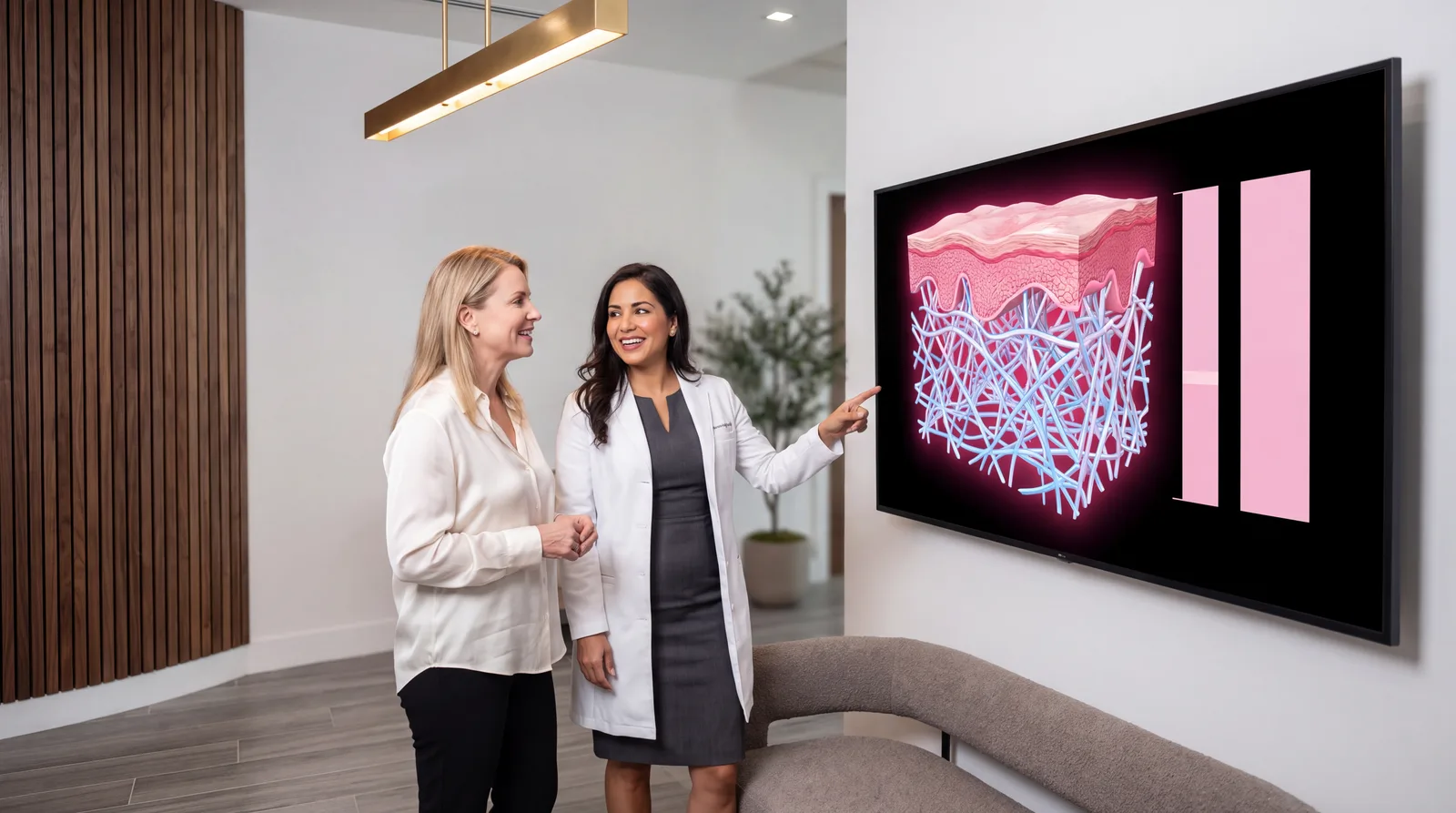
Estrogen is the most-studied skin-relevant hormone, largely because the abrupt drop at menopause produces such a clear before-and-after picture. The research is unambiguous: estrogen drives collagen synthesis, maintains skin thickness, supports hydration, and regulates skin barrier function.
The numbers are striking. Women can lose as much as 30 percent of their skin collagen in the first five years after menopause begins (Brincat et al., 1987, PMID 3601260; reviewed in Stevenson & Thornton, 2007, PMID 18044179). That is not a gradual erosion — it is a steep cliff that maps directly to the estrogen decline curve. Skin thickness drops measurably. Elasticity falls. The skin’s ability to retain moisture drops. The barrier function — your skin’s defense against environmental insult — weakens. All of this happens whether or not the patient is doing everything else right.
The practical experience for many women is a sense that their skin changed almost overnight at some point in their late 40s or early 50s. They were getting modest, predictable aging changes; then in a relatively short window, the changes accelerated. They started losing facial volume in a way topical interventions could not address. Their existing skincare stopped producing the results it had for years. This is not subjective; it is the predictable consequence of losing the primary hormone that maintains the structural integrity of their skin.
Bioidentical hormone replacement therapy addresses the substrate directly. Patients starting HRT in the early years of the menopause transition typically see slower skin thinning, better hydration, and visible improvement in skin texture and elasticity over six to twelve months. The earlier the intervention, the more skin-side benefit it tends to produce — though benefit is available even for patients starting later, particularly when combined with thoughtful aesthetic and topical strategies.
What Testosterone Does for Skin
Testosterone gets less attention in skin discussions because men typically experience a slower, more gradual decline rather than an abrupt menopause-style drop. But the cumulative effect over a decade is comparable, and the skin-side consequences are real.
Testosterone supports collagen synthesis, sebum production, and skin thickness. Men with clinically low testosterone often have thinner, drier, less resilient skin than their chronological age would predict. They may notice that wounds take longer to heal, that their skin shows sun damage more readily, or that their face has lost a certain firmness without their being able to point to a specific procedural cause.
Women produce testosterone too, in smaller amounts, and lose it gradually through their 30s and 40s. Female testosterone decline contributes meaningfully to thinning skin, reduced sebum (and the resulting dryness), and loss of overall skin tone. Female hormone protocols at Rewind often include a small testosterone component for exactly these reasons.
Restoring testosterone to physiologically optimal levels — through testosterone replacement therapy in men or through smaller-dose protocols in women — typically improves skin hydration within months and supports better skin thickness over six to twelve months. As with HRT, this is a substrate-level improvement rather than a surface-level one. It does not erase wrinkles. It changes the trajectory.
The Sebum Conversation
One caveat patients should be aware of: testosterone increases sebum production. For most patients this is an improvement — drier mature skin becomes more naturally moisturized. For some patients, particularly those with a history of acne, the increased sebum can produce a temporary acne flare in the early months of treatment. We monitor for this and adjust topical strategy accordingly. Most flares are mild and transient; some patients benefit from a coordinated dermatology consult during the early phase.
What Growth Hormone Does for Skin

Growth hormone and its downstream mediator IGF-1 drive collagen production, fibroblast activity, tissue repair, and overall skin thickness. Growth hormone secretion declines steeply with age — research has documented approximately a 14 percent decline per decade starting around age 30 (Iranmanesh et al., 1991; PMID 1939523). By your 40s, your growth hormone output is a fraction of what it was at 20.
The skin-side consequences are predictable: slower wound healing, reduced collagen production, gradually thinning skin, and decreased elasticity. Patients who pursue growth hormone optimization — typically through peptide therapy using growth hormone secretagogues like sermorelin or ipamorelin/CJC-1295 combinations — often report improvements in skin quality as part of the broader response. The mechanism here is restoring signaling your body already recognizes; secretagogues prompt your pituitary to produce more growth hormone naturally rather than introducing exogenous hormone.
For patients running a comprehensive skin-focused protocol, peptides often produce the most noticeable difference in skin thickness and texture quality. This is not the headline reason to do peptide therapy, but it is a consistent observation.
Why Topical-Only Skincare Hits a Ceiling
Topical retinoids, vitamin C, peptide serums, and the rest of the high-quality topical anti-aging arsenal all work. They have real research behind them, they produce real results, and they remain core to any sensible skin strategy. They do not, however, work in isolation when the underlying hormonal substrate has declined significantly.
The biology is straightforward. Topical retinoids signal fibroblasts to produce more collagen. If your fibroblasts are operating in a low-estrogen, low-testosterone environment, they will respond to retinoid signaling with reduced output compared to their younger selves. The signal is still there; the cellular response capacity is diminished. You can apply the perfect retinoid regimen and get a fraction of the result your daughter or younger sister would get from the same regimen.
This is why patients who address the hormonal layer first often report that their existing skincare suddenly works better. They are not imagining it. They restored some of the cellular capacity their topical actives depend on.
This is also why patients who exhaust the topical and procedural pathways without addressing hormones often hit frustrating plateaus. They have escalated to the most aggressive interventions available — high-strength peels, repeated procedural cycles, prescription-strength topicals — and the marginal returns are diminishing. The bottleneck is biological, and no amount of additional topical intervention will fix it.
Combining Hormone Therapy With Aesthetic Procedures
Hormones and procedures are not competing strategies — they are complementary layers. At Rewind, the patients pursuing serious aesthetic outcomes typically combine both.
Botox and other neuromodulators address the dynamic component of facial aging — the wrinkles produced by repeated muscle contraction. They work regardless of hormone status, but they integrate more smoothly into a face whose underlying skin is healthy and resilient. Patients on optimal hormone protocols typically find their Botox results look more natural and last slightly longer.
Volume loss from rapid weight loss is its own version of this problem: GLP-1 weight loss and “Ozempic face” covers how the rate of loss, hormones and fillers get sequenced when the face changes faster than the body.
Dermal fillers address volume loss, which is heavily hormone-mediated. Women in early menopause often lose facial fat pads in characteristic patterns; filler-based volume restoration looks more natural and integrates more durably when the underlying skin envelope is well-supported by HRT. Patients with thinning, dehydrated skin who pursue filler without addressing the substrate often need more frequent re-treatment and may struggle with results that look slightly off — the filler is right, the skin around it is the problem.
Procedural skin treatments — chemical peels, energy-based devices, more intensive procedures — benefit similarly. The downtime is similar regardless of hormone status, but the depth and durability of result tends to be better in patients whose hormonal substrate is supporting cellular repair and collagen production.
For the right patient, sequencing matters. Patients new to both hormone therapy and aesthetic procedures often see the best results from starting hormone optimization first, allowing three to six months for the substrate to improve, then layering procedural interventions on top of that improved baseline. Patients already running procedural protocols who have not addressed hormones often find that adding hormone therapy makes their existing procedural plan suddenly work better than it had.
Realistic Timelines and Expectations

Hormone-driven skin improvements are slow. This is one of the most important conversations to have with new patients pursuing aesthetic outcomes through hormone optimization.
First two to three months: Subjective improvements in hydration and texture. Skin feels different to the patient before it looks different to anyone else.
Three to six months: Visible improvements in skin texture and hydration become apparent to others. Subtle changes in skin tone evenness. Continued slow improvements in elasticity.
Six to twelve months: Structural improvements in skin thickness, more durable elasticity changes, and more noticeable improvements in overall skin quality. This is the timeline where most patients have a clear before-and-after sense.
Twelve months and beyond: The substrate-level changes consolidate. Continued slow improvement in some patients, plateau-at-improved-baseline in others. Patients who maintain their protocols typically maintain their improved baselines indefinitely.
Patients expecting dramatic transformation in the first eight weeks are typically disappointed. Patients who commit to a multi-month protocol with realistic timelines usually find that the cumulative effect, particularly when combined with thoughtful topical and procedural strategies, produces a quality of skin aging they did not believe was achievable.
How We Approach This at Rewind
For patients walking in for an aesthetic concern, our first move is rarely to schedule a procedure. We talk through the full picture — what is the patient’s hormonal status, what does their lifestyle baseline look like, what topical strategy are they already running, what aesthetic outcomes are they actually trying to achieve. The protocol that emerges typically combines hormonal substrate work with appropriate procedural support, sequenced for the patient’s situation.
Women presenting with menopause-era skin changes often start with HRT plus thoughtful topical strategy, then add fillers and Botox once the substrate has improved. Men presenting with TRT-curious symptoms that include skin changes often start with comprehensive hormone evaluation, then decide on aesthetic add-ons based on what they’re seeing six months in. Patients already running TRT or HRT who have hit aesthetic plateaus often benefit from adding peptide therapy or restylane filler protocols targeted to specific areas.
The through-line is that we treat skin aging as a multi-system problem and address it from multiple angles. We do not separate the hormone clinic from the aesthetic clinic; they are the same conversation.
Getting Started
If your skin has changed in ways that don’t seem to respond to your usual interventions, the underlying picture is worth investigating. A comprehensive hormone consult includes lab work that captures the substrate-level information topical practitioners do not have access to. From there, we can build a protocol that addresses both the biology and the visible manifestation.
You can book a consultation directly, or read what to expect from your first visit before deciding. For broader context on how hormonal changes drive aging in middle age, see our overview of anti-aging in your 40s.
Related Articles
Frequently Asked Questions
Does testosterone therapy improve skin?
Indirectly, yes — though not in the way most patients expect. Testosterone supports collagen synthesis, sebum production, and overall skin thickness. Men with low testosterone often have thinner, drier, less elastic skin than their age would predict. Restoring testosterone to optimal levels can improve hydration, slow further thinning, and produce a noticeable improvement in skin texture over several months. It is not a primary aesthetic intervention, but it removes one of the biological constraints that limit how well topical and procedural treatments can work.
Can HRT prevent or reverse wrinkles?
Estrogen plays a major role in skin collagen production — women can lose as much as 30 percent of their skin collagen in the first five years of menopause. Hormone replacement therapy can slow that loss substantially and, in many patients, produce visible improvement in skin thickness, hydration, and elasticity within months. HRT does not erase existing wrinkles, but it changes the trajectory and meaningfully amplifies the effect of topical and procedural anti-aging treatments. The earlier in the menopause transition HRT begins, the more skin-side benefit it tends to produce.
What about men's skin aging — does it work the same way?
Similar pathways, different timing. Men experience a slower, more gradual decline in testosterone and growth hormone rather than the abrupt drop estrogen makes at menopause. The cumulative effect over a decade is comparable, though — thinner skin, reduced elasticity, slower wound healing, and increased sun-damage retention. Men on properly dosed testosterone replacement typically maintain better skin quality than their unsupplemented peers.
Can I combine Botox or fillers with hormone therapy?
Yes, and it is a common combination at Rewind. The two strategies address different layers of the problem. Hormone optimization addresses the biological substrate — collagen production, skin thickness, hydration. Procedural interventions like [Botox](/services/botox/) and [dermal fillers](/services/dermal-fillers/) address the visible manifestation. Patients running both typically see better results from procedures (longer-lasting, better integration) and more durable improvements in baseline skin quality.
How long until I see skin changes from HRT or TRT?
Skin changes are slow. Hydration and texture improvements often appear within the first two to three months. Thickness and elasticity changes — which are the more meaningful structural improvements — build over six to twelve months. This is one of the reasons patients pursuing aesthetic outcomes alongside hormone therapy need to set realistic timelines. The trajectory is what matters; the snapshot at six months understates what will be visible at eighteen.
Will topical estrogen on the skin work?
Topical estrogen has real research behind it for localized skin effects — facial application of low-dose estrogen creams has been shown to improve collagen density and skin thickness in studies of postmenopausal women (Schmidt et al., 1996; PMID 8876303), though sun-exposed facial skin tends to respond less than photoprotected skin. The systemic absorption is meaningful, though, so we treat it as a clinical intervention rather than a cosmetic one. Patients interested in this approach should discuss it during a hormone consult, not pursue it through a cosmetics counter.
Does growth hormone affect skin?
Significantly. Growth hormone and its downstream mediator IGF-1 drive collagen production, fibroblast activity, and overall tissue repair. Growth hormone decline is one of the under-discussed contributors to age-related skin changes. [Peptide therapy](/services/peptide-therapy/) that supports growth hormone — sermorelin, ipamorelin/CJC-1295 combinations — can produce noticeable improvements in skin thickness and recovery over six to twelve months. We commonly include peptides in skin-focused hormone protocols for patients pursuing comprehensive aesthetic outcomes.
Should I see a hormone specialist or a dermatologist first?
Honestly, both. Dermatologists handle the topical and procedural side beautifully; what they often do not address is the hormonal substrate that limits how well topical and procedural treatments can work. We see patients who have spent thousands on topical anti-aging regimens with minimal results and discover their issue is partly hormonal. The dermatologist-only approach treats the surface; the hormone-only approach treats the substrate. The combination is what produces the best aesthetic outcomes long-term.
More in aesthetics
GLP-1 Weight Loss and "Ozempic Face": Managing the Aesthetic Side
"Ozempic face" is the aesthetic cost of rapid GLP-1 weight loss — why facial volume drops faster than body fat, and how to slow it with protein, training, and treatments.
aestheticsDermal Fillers vs Botox: Differences, Uses, and Which Is Right
Understand the key differences between dermal fillers and Botox, how each works, treatment areas, combining them, and which option is best for your goals.
aestheticsHow Long Does Botox Last? Duration, Factors, and Tips
Find out how long Botox lasts, what factors affect its duration, first-time vs repeat treatments, Botox vs Dysport longevity, and tips to extend your results.
⚕ Medical Disclaimer
The information on this page is for educational purposes only and does not constitute medical advice, diagnosis, or treatment. All treatments at Rewind Anti-Aging of Miami are performed under the supervision of licensed medical professionals. Individual results may vary. Consult your physician before beginning any new treatment protocol.
Meet our clinical team →Not sure which treatment is right for you?
Take our free 2-minute assessment and get a personalized recommendation.
Areas We Serve in Miami & South Florida
Our clinic at 24 NW 29th Street is in Wynwood & Midtown, minutes from Edgewater and Brickell. We also care for patients across Coral Gables, Aventura, Key Biscayne, and Doral — plus the entire state of Florida via telehealth.
Take the Next Step
Our team at Rewind Anti-Aging in Miami is here to help you determine if testosterone therapy is right for your goals.