
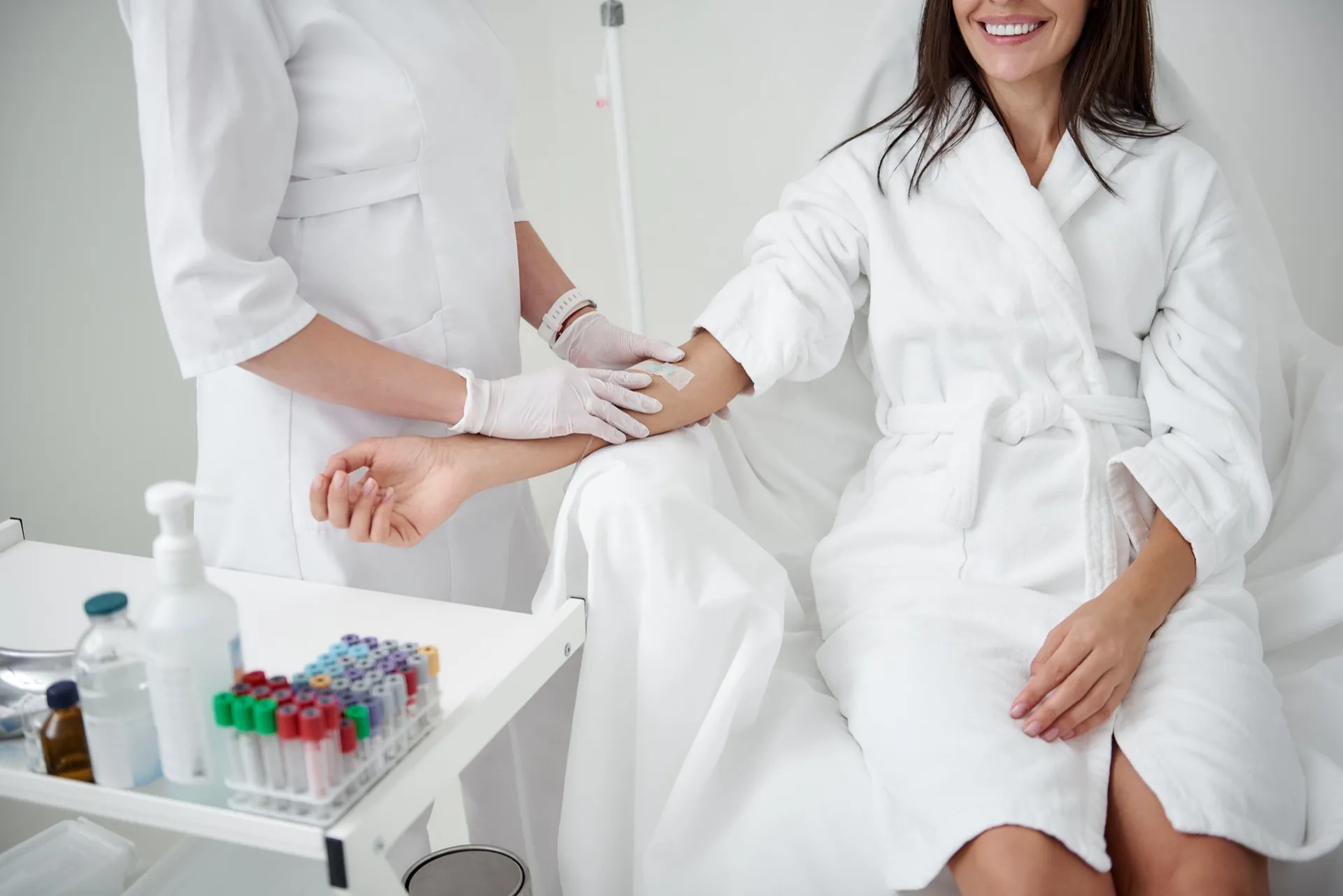
NAD+ IV Therapy & Injections
Replenish the coenzyme your cells need for energy, DNA repair, and longevity. Rewind Anti-Aging of Miami offers NAD+ as an IV infusion in the clinic and as a subcutaneous injection you give yourself at home.
What Is NAD+?
Nicotinamide adenine dinucleotide (NAD+) is a coenzyme present in every living cell in your body. It is not a vitamin, a mineral, or a drug — it is a fundamental molecule that your cells require to perform hundreds of metabolic reactions essential for life.
NAD+ exists in two forms: NAD+ (the oxidized, active form) and NADH (the reduced form). These two forms shuttle electrons between metabolic reactions. Beyond energy production, NAD+ activates key enzyme families — including sirtuins and PARPs — that govern DNA repair, gene expression, cellular stress response, and longevity pathways.
In recent years, NAD+ has become one of the most studied molecules in longevity science. Researchers have identified declining NAD+ levels as a hallmark of aging — and restoring NAD+ as a potential strategy for slowing or partially reversing age-related cellular decline. NAD+ therapy is often combined with other anti-aging approaches like peptide therapy for comprehensive results.
Ryan Smith of TruDiagnostic on the science behind NAD+ therapy.

Why NAD+ Declines with Age
In human skin, adults aged 51 to 70 averaged less than half the NAD+ of adults aged 30 to 50, and NAD+ also falls with age in the brain and in muscle. Several converging factors drive this decline.
Increased CD38 Activity
CD38 is an immune cell enzyme that consumes NAD+ as part of the inflammatory response. As chronic inflammation increases with age, CD38 activity rises, depleting more NAD+.
Increased DNA Damage
Accumulated oxidative stress and environmental toxins produce DNA damage that requires NAD+-dependent repair enzymes (PARPs) to fix. More damage means more NAD+ consumed.
Decreased Biosynthesis
The body's ability to synthesize NAD+ from precursors (tryptophan, nicotinamide, nicotinic acid) diminishes with age due to reduced enzyme efficiency.
Chronic Inflammation
Inflammation both consumes NAD+ directly and upregulates the enzymes that degrade it, creating a vicious cycle of depletion.

What NAD+ Does in Your Body
Energy & ATP Production
NAD+ is essential for mitochondrial function — converting nutrients into adenosine triphosphate (ATP), the universal energy currency of the cell. When NAD+ is depleted, mitochondrial efficiency drops and cells produce less energy.
DNA Repair via Sirtuins & PARPs
Sirtuins (SIRT1-SIRT7) are "longevity genes" entirely dependent on NAD+. PARPs are DNA repair enzymes that consume NAD+ as fuel. Without sufficient NAD+, DNA damage accumulates.
Cellular Communication
NAD+ plays a role in cell signaling pathways that coordinate stress responses, regulate circadian rhythm, and maintain metabolic homeostasis.
Neuroprotection
The brain is extremely sensitive to NAD+ depletion. NAD+ supports neuronal energy production, protects against neurodegeneration, and supports synaptic function for memory and cognition.
Benefits of NAD+ Therapy
Energy & Vitality
Improved mitochondrial function translates to sustained daily energy, reduced fatigue, and better stamina.
Cognitive Function
Better focus, mental clarity, memory, and processing speed. Many patients describe a "brain fog lifting" effect.
Anti-Aging
Supporting sirtuins, DNA repair, and cellular resilience at the molecular level addresses aging at its root cause.
Athletic Recovery
Faster recovery from intense training, reduced muscle soreness, and improved performance capacity.
Addiction Support
NAD+ therapy has a history of use in addiction medicine, helping reduce withdrawal symptoms, cravings, and neurological damage from substance abuse.
Mood & Well-Being
Improved neurotransmitter function and cellular energy support better emotional resilience and overall well-being.
Dosing & Administration
In the clinic, NAD+ is given by intravenous infusion, which delivers it straight into the bloodstream and bypasses the digestive system. In the first human study of IV NAD+, a 750 mg infusion over 6 hours left plasma NAD+ unchanged for the first 2 hours, then raised it to about 400% above baseline by the end.
Standard dose for general anti-aging support, energy enhancement, and maintenance.
Mid-range dose for cognitive optimization, athletic recovery, and moderate NAD+ depletion.
High dose for intensive protocols including addiction support, severe fatigue, and maximum cellular replenishment.
Each session takes approximately 2-4 hours. The slower rate minimizes side effects and maximizes comfort.
Side Effects
Side effects are generally related to infusion rate and are manageable by slowing the drip.
The most commonly reported sensation. Not dangerous but can be uncomfortable. Slowing the infusion rate resolves it within minutes.
Occurs when the infusion is too fast. Managed by reducing the drip rate.
Occasionally reported, typically mild and transient.
Rare, usually related to not eating adequately before the session.
Mild warmth or flushing sensation that resolves as the body processes the NAD+.
These effects are rate-dependent — our clinical team is experienced in finding the optimal drip rate for each patient.
NAD+ Injections in Miami
Rewind also prescribes NAD+ as a subcutaneous injection — a small injection under the skin that you give yourself at home, in place of a 2-to-4-hour infusion in the clinic chair.
Each vial holds 2,000 mg of NAD+ (10 mL at 200 mg per mL). Your Rewind provider sets your dose and injection schedule and adjusts them as you go.
Where and how long
Injection: At home, on the schedule your provider sets.
IV infusion: In the clinic, 2 to 4 hours per session.
Route
Injection: Under the skin (subcutaneous).
IV infusion: Into a vein, dripped slowly.
Common reactions
Injection: Redness, swelling, or tenderness where you inject; flushing, nausea, or lightheadedness if it goes in too quickly. Rotate injection sites.
IV infusion: Chest tightness, nausea, flushing, or cramping, eased by slowing the drip.
Your NAD+ Treatment Protocol
From initial loading to ongoing maintenance — designed for maximum cellular benefit.
Consultation
Discuss your goals, symptoms, and health history to determine the right NAD+ dosing protocol.
Loading Phase
3 to 5 sessions over one to two weeks to rapidly replenish depleted NAD+ stores.
Infusion Sessions
Each session takes 2-4 hours. Our team adjusts the drip rate for your comfort throughout.
Maintenance
Once-monthly infusions to sustain optimal NAD+ levels long-term.
Related Treatments
IV Vitamin Therapy
Custom IV vitamin infusions including Myers' Cocktail, glutathione, vitamin C, and hydration drips.
Learn more →TrueAge Epigenetic Test
Measure your true biological age through DNA methylation analysis to track and validate anti-aging treatments.
Learn more →Peptide Therapy
Explore our full suite of therapeutic peptides for anti-aging, recovery, and performance optimization.
Learn more →Explore NAD+ Therapy
Frequently Asked Questions
What does NAD+ stand for?
NAD+ stands for nicotinamide adenine dinucleotide. It is a coenzyme found in every living cell in your body. The '+' sign refers to its oxidized form, which is the active form that participates in metabolic reactions. NAD+ is essential for converting food into cellular energy (ATP), activating DNA repair enzymes (sirtuins and PARPs), regulating circadian rhythm, and maintaining cellular communication. Without NAD+, your cells cannot function — it is literally required for life.
Why do NAD+ levels decline with age?
NAD+ levels decline due to a combination of factors: increased activity of CD38, an enzyme that consumes NAD+ as part of the immune and inflammatory response; increased demand for DNA repair as accumulated cellular damage rises with age; decreased production of NAD+ precursors; and chronic inflammation, which accelerates NAD+ consumption. In human skin, adults aged 51 to 70 averaged less than half the NAD+ of adults aged 30 to 50, and NAD+ also falls with age in the brain and in muscle. This decline is increasingly recognized as a driver of — not just a consequence of — the aging process.
How long does an NAD+ IV infusion take?
NAD+ IV infusions typically take 2 to 4 hours depending on the dose. The infusion must be administered slowly because rapid infusion commonly causes uncomfortable side effects — particularly chest tightness, nausea, and cramping. Our clinical team adjusts the drip rate throughout the session to ensure comfort. Most patients read, work on their laptop, or relax during the infusion. We offer a comfortable clinical environment designed for extended IV therapy sessions.
How many NAD+ sessions do I need?
Most patients begin with a loading phase of 3 to 5 sessions over one to two weeks to rapidly replenish depleted NAD+ stores. After the loading phase, maintenance infusions are typically scheduled once monthly to sustain optimal levels. Some patients, particularly those using NAD+ for addiction support or intensive anti-aging protocols, may benefit from more frequent sessions initially. Your provider will design a protocol based on your goals, baseline health, and response to treatment.
What does NAD+ therapy feel like?
During the infusion, some patients experience a warm sensation in the chest, mild nausea, or abdominal cramping — these are common reactions to NAD+ and are managed by slowing the infusion rate. Most patients tolerate the infusion well once the drip rate is optimized. After the infusion, the most commonly reported experiences are increased mental clarity, improved energy, and a sense of overall well-being. Many patients describe feeling 'switched on' or 'clear-headed' in the hours and days following treatment. The benefits tend to be cumulative over multiple sessions.
Can I take oral NAD+ supplements instead of IV therapy?
Oral NAD+ precursors — such as nicotinamide riboside (NR) and nicotinamide mononucleotide (NMN) — are available as supplements and raise NAD+ in human trials: in one six-week trial, 1,000 mg of NR a day raised NAD+ in blood cells by about 60%. The body converts these precursors into NAD+. IV NAD+ delivers the coenzyme directly into the bloodstream, and an NAD+ injection delivers it under the skin; both bypass the digestive system. Your provider will recommend the route that fits your goals and schedule.
What are NAD+ injections?
NAD+ injections deliver nicotinamide adenine dinucleotide under the skin (subcutaneously) instead of through an IV. At Rewind, NAD+ injections come as a 10 mL vial of 200 mg/mL NAD+ that you inject yourself at home, on the dose and schedule your provider sets — no 2-to-4-hour clinic infusion for each dose.
What side effects do NAD+ injections cause?
The most common are redness, swelling, or tenderness where you inject, and flushing, nausea, or lightheadedness if the dose goes in too quickly. Headache and fatigue are also reported. Rotating injection sites helps with local soreness.
Recharge at the Cellular Level
NAD+ therapy targets aging where it starts — inside your cells. Schedule a consultation to learn how NAD+, by IV infusion or at-home injection, can restore your energy, cognition, and resilience.
⚕ Medical Disclaimer
The information on this page is for educational purposes only and does not constitute medical advice, diagnosis, or treatment. All treatments at Rewind Anti-Aging of Miami are performed under the supervision of licensed medical professionals. Individual results may vary. Consult your physician before beginning any new treatment protocol.
Meet our clinical team →Areas We Serve in Miami & South Florida
Our clinic at 24 NW 29th Street is in Wynwood & Midtown, minutes from Edgewater and Brickell. We also care for patients across Coral Gables, Aventura, Key Biscayne, and Doral — plus the entire state of Florida via telehealth.