

Ready to explore testosterone therapy?
Schedule a free consultation with our medical team in Miami.
The question of online TRT vs in person care gets argued badly from both directions. Telehealth platforms present the office visit as friction someone invented to charge you for parking. Local clinics present telehealth as reckless. Neither is right, and the actual difference is narrower and far more specific than either side says.
Both models prescribe the same medication, order the same labs from the same reference laboratories, and follow the same clinical guidelines when they are practising properly. What differs is a short, concrete list of things that require a body in a room. This article is that list — plus an honest account of who each model genuinely suits.
What Both Models Do Identically
Worth clearing first, because a lot of marketing depends on blurring it.
The medication is the same. Testosterone cypionate is testosterone cypionate. Whether it came from a compounding pharmacy contracted by a telehealth platform or one used by your local clinic, the molecule and the pharmacology are unchanged.
The labs are the same. Both models draw at Quest, Labcorp or an equivalent. Nobody has a proprietary testosterone assay.
The guidelines are the same. The AUA and Endocrine Society recommendations on diagnosis, thresholds and monitoring do not have a telehealth exception (1, 2). Two separate morning total testosterone measurements before diagnosis, evaluation for secondary causes, and scheduled monitoring of hematocrit, PSA and symptoms apply either way.
The prescriber may be equally qualified. Some telehealth services are staffed by genuinely expert hormone clinicians. Some local clinics are not. Credential is not a proxy for setting.
So the real question is not which model is better in principle. It is what happens in the specific situations where the two diverge.
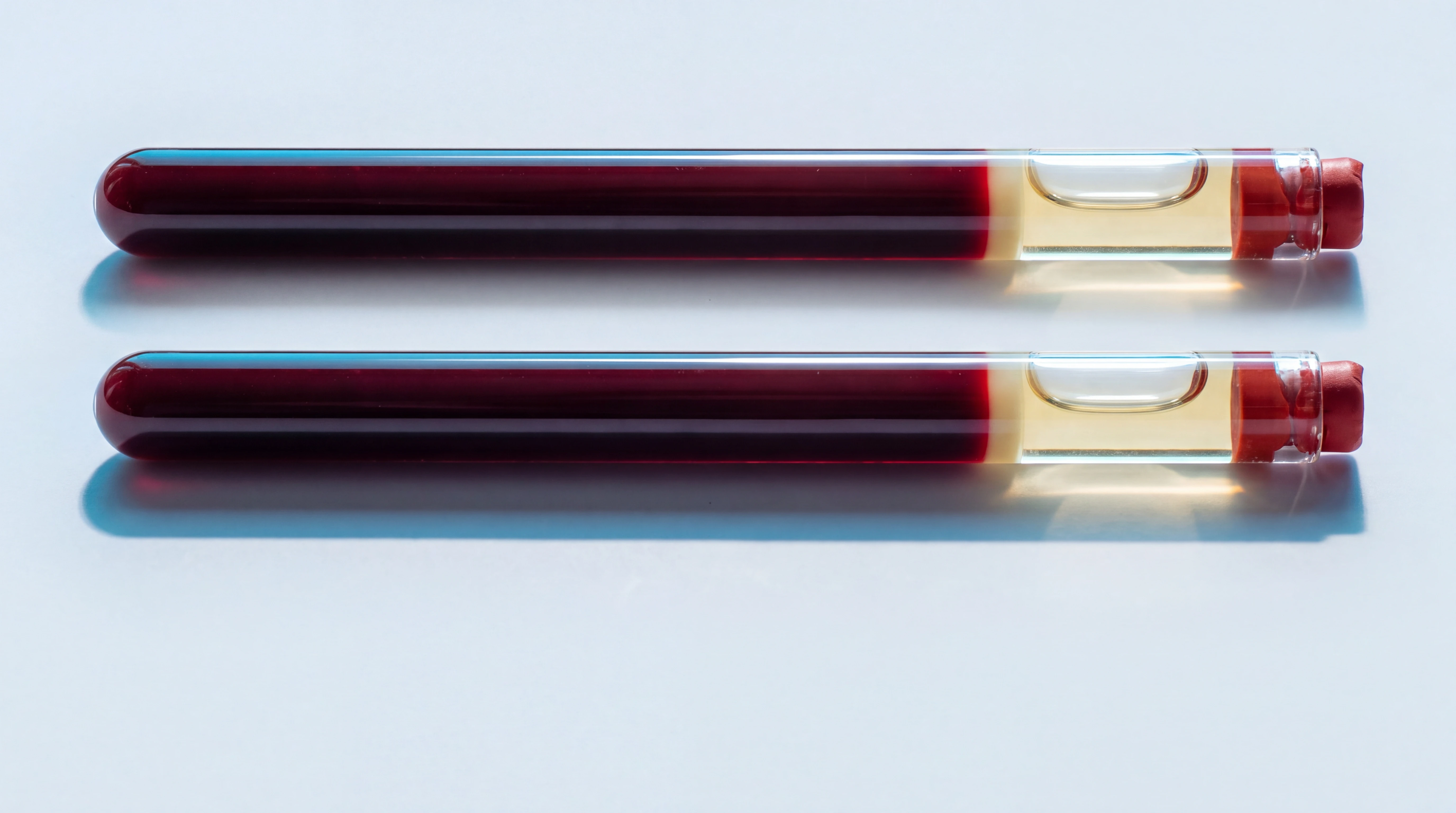
Online TRT vs In Person: The Five Places They Actually Diverge
1. Physical examination
Guidelines call for a physical examination as part of evaluating testosterone deficiency, and it is not a formality. A testicular examination can identify a varicocele, asymmetry or a mass — the latter being a rare but genuinely important finding in a man presenting with hormonal symptoms. Testicular volume assessment establishes a baseline for the atrophy that TRT produces, which is the whole reason adjuncts that preserve testicular function belong in the conversation at the start rather than two years in. Gynecomastia assessment, thyroid palpation and prostate examination where indicated all require hands.
A video call cannot do any of this. That is not a criticism of telehealth; it is a description of what a camera is.
2. Therapeutic phlebotomy
This is the most practically important item on the list because it is the most common complication of TRT.
Testosterone stimulates erythropoiesis, and hematocrit rises in a meaningful proportion of men on therapy. Guidelines set thresholds at which action is required — typically dose reduction, and often therapeutic phlebotomy to bring the value down (1). A telehealth service can detect the rise on a lab result and can reduce your dose. It cannot remove blood.
What follows is a referral to a blood centre or a local provider, and the man in the middle discovers he needs a local relationship after all — at the moment when he already has a problem.
3. Injection technique and adjunct medications
For a man on weekly intramuscular testosterone with a pre-filled syringe, a video demonstration is genuinely sufficient. Millions of people self-administer injectable medication competently after watching one.
It stops being sufficient when the protocol gets more involved. Subcutaneous dosing with site rotation, hCG that arrives as a lyophilised powder requiring reconstitution arithmetic, or any multi-vial protocol all benefit substantially from someone watching you do it once. Reconstitution errors in particular are common, silent, and produce doses off by a factor of two or four — which then shows up as an inexplicable lab result nobody can account for.
4. Body composition
TRT changes body composition, and the number on the scale cannot tell you whether it changed in the right direction. A man who gains eight pounds on therapy has either added lean mass — the intended result — or added fat, or both. Bioimpedance or DEXA answers this in a few minutes and is one of the more motivating measurements in the whole programme.
Almost no telehealth service can offer it, and the substitute usually proposed — send us a photo — is not a measurement.
5. Speed when something goes wrong
Most of TRT is routine. The exceptions are where the models separate. Chest pain, a swollen calf, a hematocrit at 56 percent, a PSA jump, a testicular lump, breast tenderness with a rising estradiol: all of these need to be seen, and some need to be seen this week.
A local clinic can put you in a chair. A telehealth service can message you and direct you somewhere else.

Where Telehealth Is Genuinely Better
Being fair, because this is not a one-sided comparison.
Access. A large share of men with symptomatic testosterone deficiency never get evaluated, and the friction of finding a clinic and taking time off is a real reason. A service reachable from a phone converts some of those men into treated patients. That is a public health win, not a compromise.
Cost. Scale and standardised protocols make telehealth cheaper, and for a straightforward case that is genuine value rather than a corner cut.
Convenience of routine follow-up. A twelve-minute conversation about how you feel and what your labs show does not require anyone to drive anywhere. This is true of most TRT appointments after the first few.
Consistency. A well-run platform applies the same protocol every time. Small independent clinics vary considerably in quality, and some of that variation is worse than a standardised protocol.
Geography. For men not near a competent hormone clinic, telehealth is not the second-best option — it is the only one.
Which Model Fits Which Patient
| Your situation | Better served by |
|---|---|
| Straightforward secondary hypogonadism, under 45, no comorbidities | Telehealth handles this well |
| Cost is the binding constraint | Telehealth, with a plan for where to go if something arises |
| Not near a competent hormone clinic | Telehealth |
| Over 50, or any prostate or cardiovascular history | In-person, at least for the workup and periodic review |
| Hematocrit already at the upper end, or a history of erythrocytosis | In-person — you will need phlebotomy access |
| Fertility matters, or hCG is part of the plan | In-person to start, for technique and semen analysis |
| Complex picture — thyroid, pituitary abnormality, prior anabolic steroid use | In-person |
| Previous TRT that did not work or produced problems | In-person; this needs a full re-evaluation, not a new prescription |
| Part-year resident splitting time between states | Hybrid, deliberately structured |
The pattern in that table is straightforward. Telehealth is well matched to the uncomplicated case. In-person earns its cost when the case is complicated, or when it becomes complicated — which a meaningful minority do.

The Hybrid Model, Which Is What Most Men Should Want
Framing this as a binary is the actual mistake. We run telemedicine appointments ourselves, and for routine reviews they are simply better — faster for the patient and no worse clinically.
The split that works:
In person: the initial workup and physical examination, body composition at baseline and at intervals, injection technique the first time and whenever the protocol changes, therapeutic phlebotomy, in-office dosing where it applies, and anything that has gone wrong.
Remote: routine result reviews, dose adjustments, symptom check-ins, prescription management, and questions between visits.
Either: the lab draw, which happens at a reference laboratory in both models and is never the differentiator.
For South Florida this matters more than elsewhere, because so many patients are here for part of the year. Clustering the in-person items into the months you are in Miami and doing everything else remotely is not a compromise — for that patient it is the better design.
The Cost Comparison, Honestly
Headline prices are not comparable, because the two models bundle different things. Put them on the same grid before concluding anything.
| Line item | Typical telehealth | Typical in-person |
|---|---|---|
| Initial workup | Often a limited panel, sometimes included in a starter fee | Comprehensive panel, usually billed separately |
| Physical examination | Not performed | Included |
| Medication | Frequently bundled into a monthly fee | Usually billed at pharmacy cost |
| Follow-up labs | Defined intervals, panel often narrow | Defined intervals, panel usually broader |
| Body composition | Not available | Included or low-cost |
| Therapeutic phlebotomy | Referred out, cost external | In-house |
| Clinical time between visits | Message-based, variable | Varies by practice |
Two honest observations. First, telehealth genuinely is cheaper for the uncomplicated case, and pretending otherwise is not a real argument. Second, the comparison inverts when something needs handling, because handling it usually means acquiring a local provider — and a workup performed twice costs more than a workup performed once.
The useful way to think about the premium is as the price of the exam, the equipment and the ability to escalate. If you are in a group where none of those will be needed, you are paying for something you will not use. If you are in a group where one of them will, it is not a premium at all.
What a Proper Initial Panel Contains
This is the single best test of a service, in either model, and it is easy to check before committing.
Diagnosis of testosterone deficiency:
- Total testosterone, twice, both drawn in the morning. One measurement is not a diagnosis — biological variability alone means a single low value is frequently normal on repeat.
- Free testosterone, calculated or measured, with SHBG. Total testosterone alone is misleading in anyone with an abnormal SHBG, which is common in obesity, insulin resistance and thyroid disease. SHBG and what it does covers why.
- LH and FSH, to distinguish primary from secondary hypogonadism. This changes the treatment entirely, and it cannot be worked out afterwards once therapy has suppressed both.
- Prolactin, because a prolactinoma presents exactly like this and is a diagnosis you do not want to miss.
Ruling out what else it could be:
- A full thyroid panel with free T3, free T4 and antibodies, not TSH alone.
- Iron studies with ferritin — both deficiency and haemochromatosis cause fatigue and low testosterone.
- CBC and a comprehensive metabolic panel.
- Fasting glucose, HbA1c and ideally fasting insulin.
Baseline for monitoring:
- Estradiol on a sensitive assay. The standard immunoassay is unreliable at male concentrations.
- PSA in men over 40, with a documented baseline before therapy begins.
- Lipids, ideally with apoB.
If a service diagnoses from a symptom questionnaire and a single total testosterone, everything downstream is built on an unsound foundation. That failure is far more common than any failure attributable to being online — and it happens in offices too.
What to Ask Before You Sign Up, Either Way
These questions sort good services from poor ones more reliably than the model does.
- How many testosterone measurements before you will diagnose me, and at what time of day? The answer should be two, both morning. One afternoon draw is not a diagnosis.
- What else is on the initial panel? Free testosterone, SHBG, estradiol on a sensitive assay, LH and FSH, prolactin, a full thyroid panel, iron studies, CBC, CMP, lipids and PSA if over 40. A total testosterone alone is a sales funnel.
- What is the monitoring schedule? Hematocrit, estradiol, PSA and symptoms at defined intervals — not “as needed”.
- What happens if my hematocrit rises? A specific plan, including where phlebotomy happens.
- Will I see the same clinician? Continuity is what makes a trend interpretable.
- What is your protocol if fertility becomes a concern? The answer should involve hCG and a semen analysis, not a shrug.
- How do you comply with controlled substance rules for remote prescribing? Testosterone is Schedule III. A clear answer is a good sign in itself.
A service that answers all seven crisply is worth considering regardless of whether it has a waiting room. One that cannot is not, for the same reason.
The Short Version
If you are 38, otherwise healthy, symptomatic, and your labs are unambiguous, a well-run telehealth service will look after you competently and for less money. That is a real answer and we are not going to talk you out of it.
If you are over 50, if you have a prostate or cardiovascular history, if your hematocrit already sits high, if fertility is anywhere in the plan, if you have used anabolic steroids before, or if a previous course of TRT went badly — get examined in person, at least for the workup. Those situations are exactly the ones a camera cannot assess, and they are more common than the marketing on either side suggests.
And if you fall in the middle, which most men do, the hybrid is not a compromise. It is the design that puts each appointment where it actually works.
Switching Providers
If you are moving from a telehealth service to a local clinic — or the reverse — bring three things.
Your complete lab history, including the pre-treatment baseline. This is the item most often missing and the most valuable, because without it nobody can establish whether therapy was indicated in the first place.
Your exact current protocol. Ester, dose, frequency, route, and every adjunct: hCG, anastrozole, enclomiphene, anything else.
An honest history, including any prior anabolic steroid use. It changes the interpretation of everything and it is not a moral question.
Expect a fresh comprehensive panel and a physical examination before anything is changed. A clinic that continues an unfamiliar protocol without re-establishing the baseline is doing you no favours.
If you are still deciding whether to start at all, testosterone therapy cost covers what the numbers actually look like, and first 30 days on TRT covers what starting feels like. Our own workup is described under testosterone therapy.
Want a proper baseline and an examination before deciding? Book a consult with our Miami team.
Medical disclaimer: This article is for educational purposes only and is not a substitute for professional medical advice, diagnosis, or treatment. Consult a qualified clinician before starting or changing hormone therapy.
Sources
- Mulhall JP, Trost LW, Brannigan RE, et al. Evaluation and Management of Testosterone Deficiency: AUA Guideline. The Journal of Urology. 2018;200(2):423–432.
- Bhasin S, Brito JP, Cunningham GR, et al. Testosterone Therapy in Men With Hypogonadism: An Endocrine Society Clinical Practice Guideline. The Journal of Clinical Endocrinology & Metabolism. 2018;103(5):1715–1744.
- Ohlander SJ, Varghese B, Pastuszak AW. Erythrocytosis Following Testosterone Therapy. Sexual Medicine Reviews. 2018;6(1):77–85.
- Jasuja GK, Bhasin S, Reisman JI, et al. Ascertainment of Testosterone Prescribing Practices in the VA. Medical Care. 2015;53(9):746–752.
Frequently Asked Questions
Is online TRT safe?
It can be, and the determining factor is not the platform but whether proper diagnosis and monitoring are actually happening. A telehealth service that requires two morning testosterone measurements, checks LH, FSH, prolactin, a thyroid panel and iron studies before diagnosing, and re-tests hematocrit, estradiol and PSA on schedule is practising to guideline. One that prescribes from a symptom questionnaire and a single afternoon lab is not, and that is unsafe whether it happens online or in an office.
What can an in-person TRT clinic do that a telehealth service cannot?
Five things, concretely: a physical examination including testicular and prostate assessment; therapeutic phlebotomy when hematocrit rises above threshold, which is the most common dose-limiting problem on TRT; hands-on injection technique training, which matters most for subcutaneous dosing, hCG reconstitution and any injectable protocol; body composition measurement to show whether gains are lean mass or fat; and same-week escalation when something is wrong. None of these are exotic — most men encounter at least one.
Is online TRT cheaper?
Usually, and honestly so. Telehealth platforms operate at scale with standardised protocols and lower overhead, and for a straightforward case that efficiency is real value rather than a corner being cut. The comparison becomes less favourable when a problem appears, because handling it typically means finding a local provider anyway — and a workup done twice costs more than a workup done once.
Can a telehealth doctor prescribe testosterone in Florida?
Yes, provided the prescriber is licensed in Florida and the encounter meets state telemedicine requirements. Testosterone is a Schedule III controlled substance, so both federal and state rules on remote prescribing of controlled substances apply, and those rules have been revised repeatedly since 2020. A legitimate service will be explicit about how it complies. A service unable to answer that question clearly is one to leave.
What is the hybrid model and who is it for?
Local for the parts that need a body in the room — initial workup and examination, body composition, injection technique, in-office dosing, therapeutic phlebotomy, and any problem-solving — with lab draws at a national reference lab and routine reviews by telemedicine. It suits most men, and it particularly suits South Florida's large part-year population, where in-person visits cluster into the months they are actually here.
How do I switch from an online TRT provider to a local clinic?
Bring three things: your complete lab history including the pre-treatment baseline, your exact current protocol with doses and frequency, and any adjunct medications such as hCG or an aromatase inhibitor. The pre-treatment baseline is the one most often missing and the most valuable — without it, nobody can tell whether therapy was indicated. Expect a fresh comprehensive panel and a physical examination before any change is made.
More in hormones
Starting Hormone Therapy in Miami: First Visit to First Prescription
Starting hormone therapy in Miami, step by step: the consultation, body scan and blood panel, the results review, your prescription, and the first follow-up labs.
hormonesWhen Does Perimenopause Start? Earlier Than You Think
When does perimenopause start? Often the late 30s to early 40s — years before menopause. Here are the early symptoms, why labs look normal, and treatment options.
hormonesThyroid Symptoms That Get Missed (and Why)
Thyroid symptoms like fatigue, weight gain, and brain fog are often missed by TSH-only testing. Here's why a full thyroid panel may matter.
⚕ Medical Disclaimer
The information on this page is for educational purposes only and does not constitute medical advice, diagnosis, or treatment. All treatments at Rewind Anti-Aging of Miami are performed under the supervision of licensed medical professionals. Individual results may vary. Consult your physician before beginning any new treatment protocol.
Meet our clinical team →Not sure which treatment is right for you?
Take our free 2-minute assessment and get a personalized recommendation.
Areas We Serve in Miami & South Florida
Our clinic at 24 NW 29th Street is in Wynwood & Midtown, minutes from Edgewater and Brickell. We also care for patients across Coral Gables, Aventura, Key Biscayne, and Doral — plus the entire state of Florida via telehealth.
Take the Next Step
Our team at Rewind Anti-Aging in Miami is here to help you determine if testosterone therapy is right for your goals.