

Ready to explore hormone therapy?
Schedule a free consultation with our medical team in Miami.
Most people who book a hormone consultation have been living with the symptoms for a while: fatigue that sleep does not fix, weight that moved to the middle, low libido, brain fog, broken sleep or hot flashes. The decision to do something about it is the hard part. What happens next should not be a mystery.
This is the path to starting hormone therapy in Miami at Rewind Anti-Aging of Miami, for men and for women, from the first appointment to the first prescription and the first follow-up labs. At every step the rule is the same: nothing is prescribed without lab work behind it, and nothing moves forward without your understanding and consent.
Before your first visit
A little preparation makes the first visit more useful:
- Fast for 8 to 12 hours before your appointment. Water is fine. Fasting keeps your blood work accurate.
- Wear comfortable clothing for the body composition scan.
- Bring a valid photo ID and a list of your current medications and supplements, with doses.
- Bring recent lab work if you have it. It is useful, but not required.
- Write down your top three goals. “More energy” and “sleep through the night” are perfectly good answers.
- Complete the intake forms we email you beforehand.
You do not need a referral. Rewind is a direct-access clinic.
Step 1: The consultation
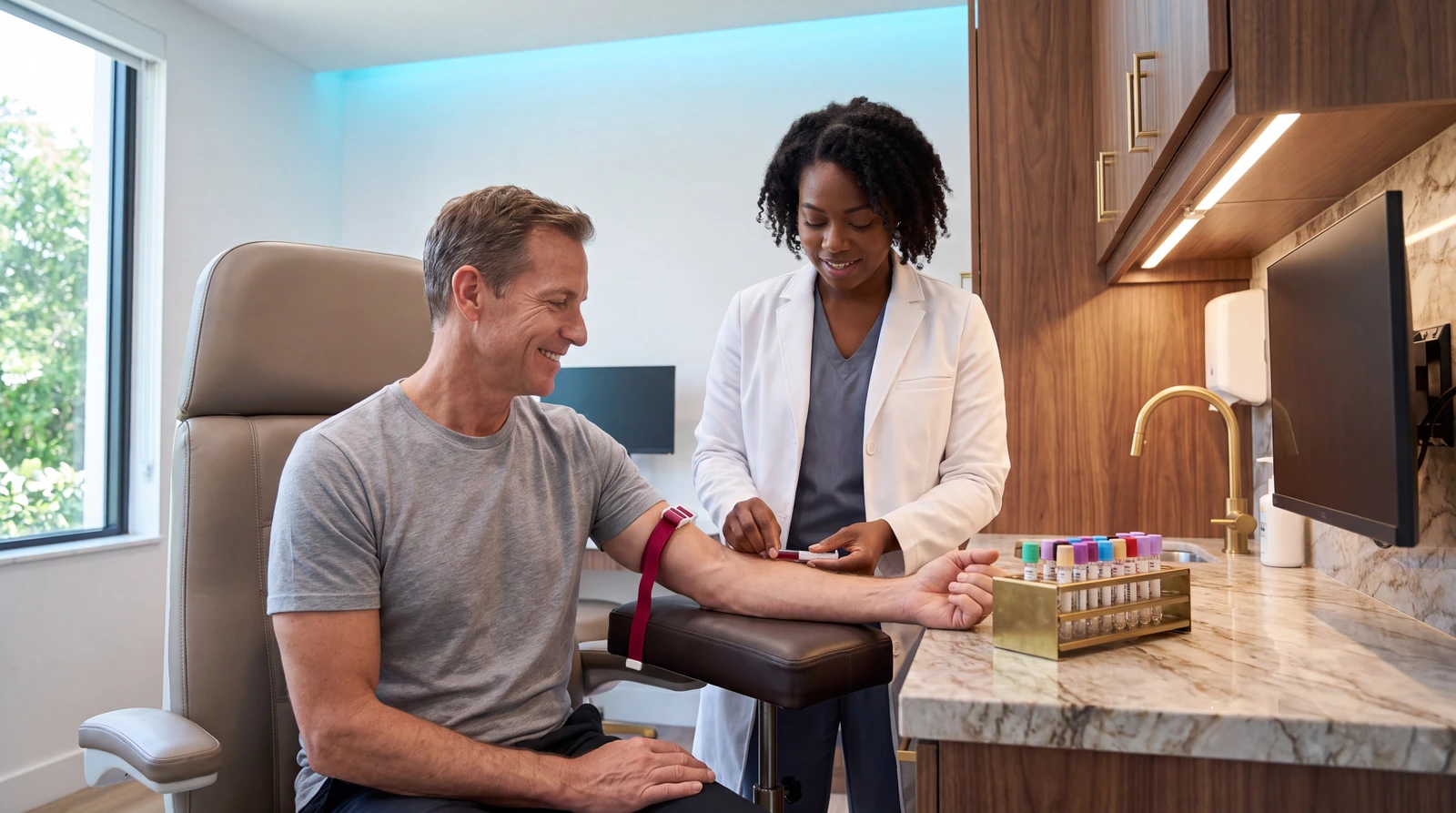
Your provider starts by listening. The conversation covers your symptoms, how long you have had them, your medical history, current medications, sleep, stress, training and what you want to change. For women, it includes where you are in perimenopause or menopause. For men, it includes whether you may want children in the future, because that shapes which options make sense.
Hormones rarely act alone, so the consultation looks at the whole picture: thyroid, adrenal and metabolic health, not only estrogen or testosterone.
Step 2: Body composition scan and blood panel
Two measurements give your provider a baseline.
An InBody body composition scan. It measures lean muscle mass, body fat percentage, visceral fat and hydration. That is a far better baseline than body weight, and it is repeated later to show what treatment is changing.
A comprehensive blood panel. A simple blood draw at the clinic. Rewind’s hormone panel covers:
| Area | What is measured |
|---|---|
| Sex hormones | Total and free testosterone, estradiol, progesterone, DHEA-S, SHBG |
| Pituitary signals | LH and FSH |
| Thyroid | TSH, free T3, free T4 |
| Stress | Cortisol |
| Blood and metabolism | CBC, comprehensive metabolic panel, lipid panel, insulin, hemoglobin A1c |
| Nutrients | Vitamin D |
| Prostate (men) | PSA |
A standard annual physical checks a fraction of these. The wider panel is what lets your provider see why you feel the way you do, and which markers treatment will be checked against later.
Step 3: Your results review
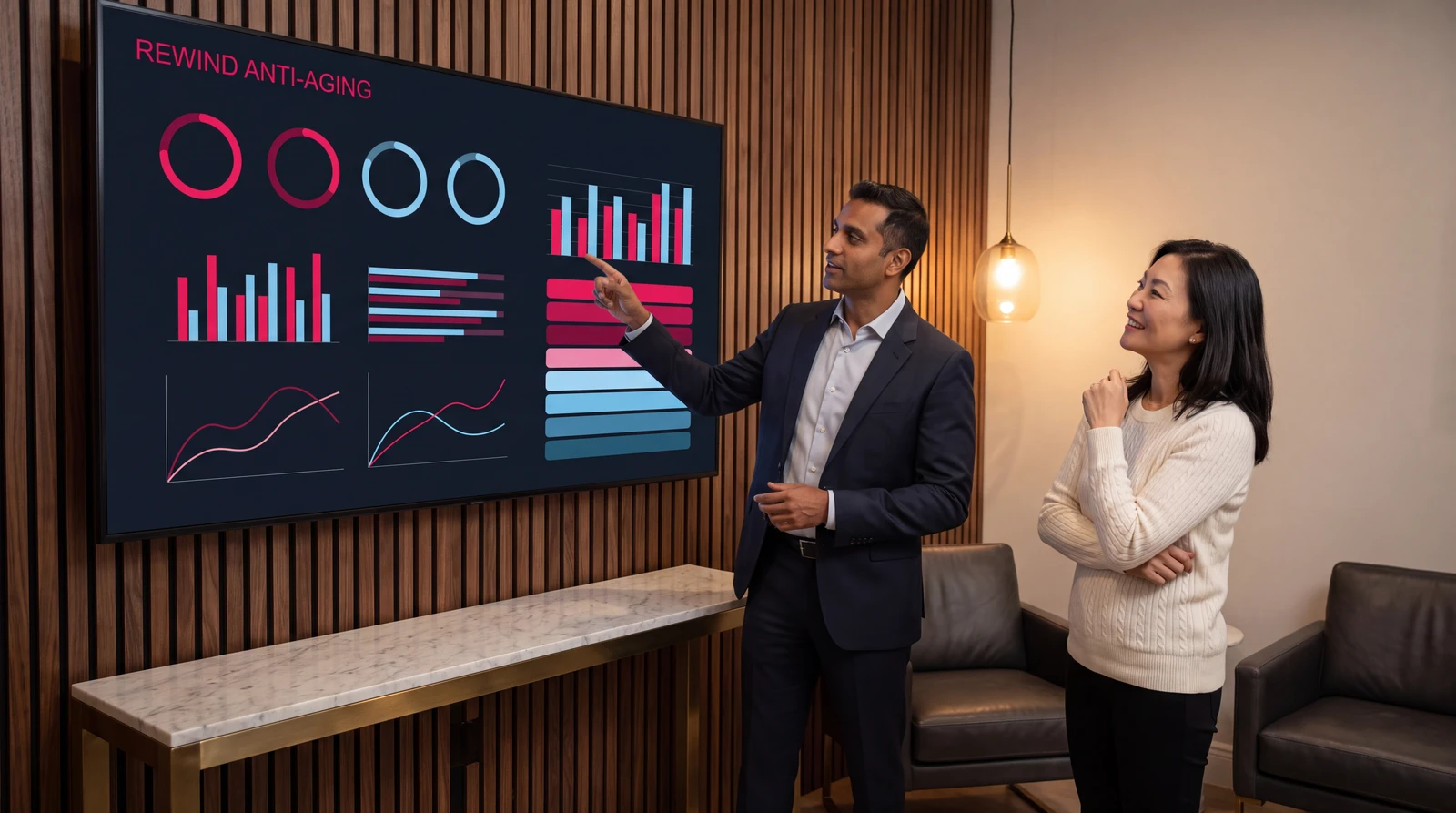
When your results are in, you return for a detailed review. Your provider walks you through every number and shows where you fall against optimal ranges, not only the “normal” range printed on the lab report. A testosterone level can be technically normal and still far from where you feel and perform your best. The same is true of estradiol, progesterone and thyroid.
This is the conversation where your symptoms and your numbers are put side by side, and where your questions get answered before anything is decided.
Questions to bring to your results review
The review is your best chance to understand your own numbers. It helps to bring questions like these:
- Which of my results explain the symptoms I came in with?
- Which markers are in range but not where you would want them, and why does that matter for me?
- What would you treat first, and what would you watch instead?
- Which markers will you check at my first follow-up, and what are you hoping to see?
- What would make you change the plan?
Step 4: Your protocol
Based on your labs, symptoms, goals and health history, your provider designs a protocol that specifies:
- Which hormones you need. For women, commonly bioidentical estradiol, micronized progesterone and sometimes low-dose testosterone. For men, most often testosterone, with support for estradiol or fertility when needed.
- The delivery method. Injections, creams, patches or pellets, each with trade-offs in steadiness, flexibility and daily effort. For men, testosterone cypionate injections are the most commonly prescribed method. For women, transdermal estradiol is prioritized for its safety profile.
- The dose and schedule, set from your labs.
- Your monitoring plan, with the dates of your follow-up blood work.
For men, fertility is part of this step. Testosterone therapy reduces sperm production, so if children are in your plans, options that preserve fertility are discussed before anything starts. Our guide to TRT vs HRT explains how men’s and women’s protocols differ.
Step 5: Your prescription and training
Your prescription is written in your name and filled by a pharmacy. If your protocol uses injections, we teach you the technique so you can do them at home. For creams and patches, your provider explains where and when to apply them.
Step 6: The first weeks and the first follow-up labs
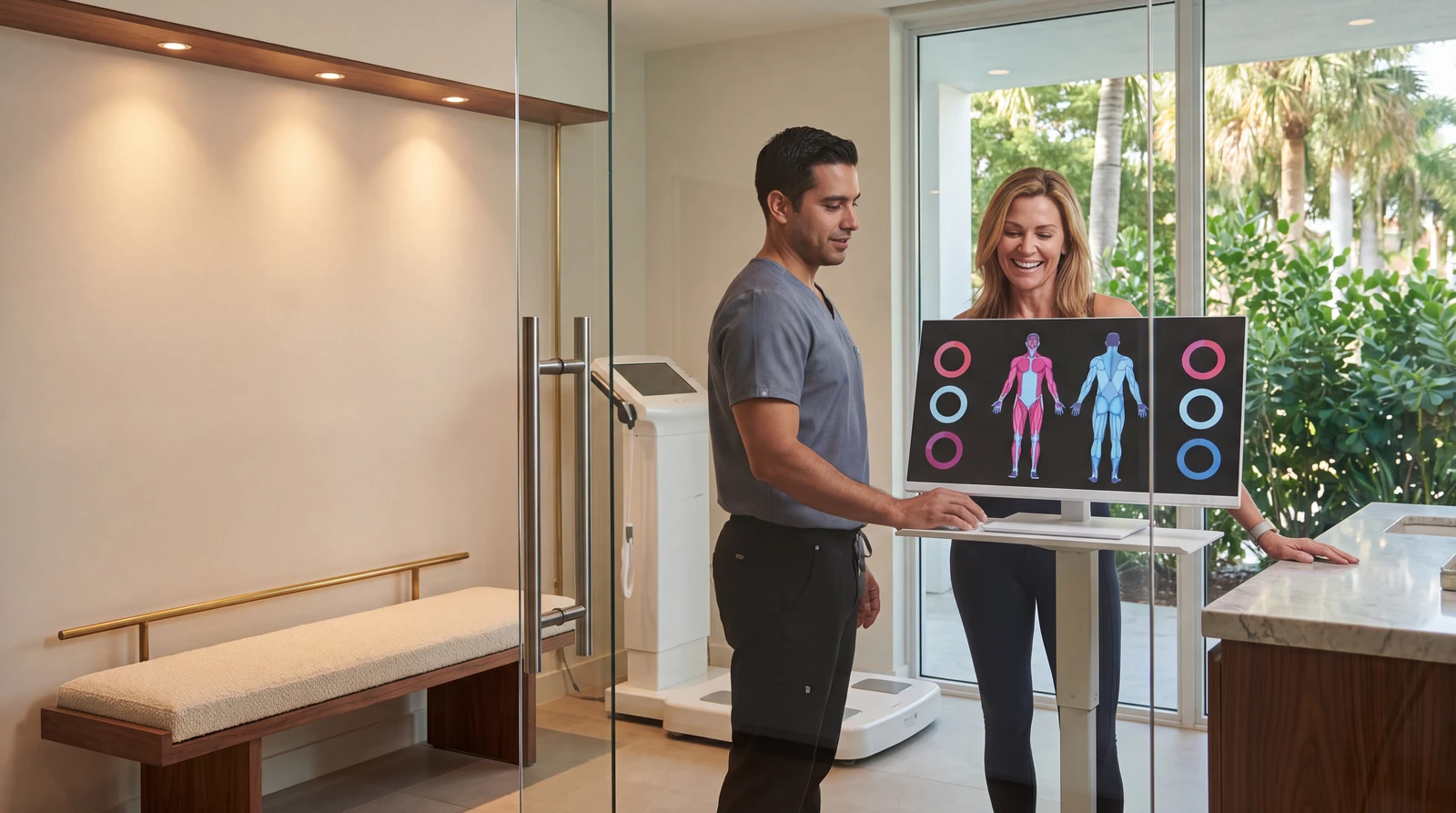
Most patients notice early gains in energy and sleep within a few weeks, with fuller benefits over two to three months as levels stabilize. Everyone responds differently, which is why the monitoring plan matters as much as the prescription. Your body composition scan is repeated as treatment progresses, so changes in lean mass and body fat are measured rather than guessed.
Your first follow-up blood panel is 6 to 8 weeks after starting. Your provider compares it with your baseline and with how you feel, and adjusts the dose if needed. Once your protocol is stable, monitoring moves to every 3 to 6 months. Follow-up visits can be done by telehealth, so staying on schedule does not always mean a trip to Wynwood.
If you are starting testosterone, our week-by-week guide to your first 30 days on TRT covers what that first month tends to look like.
Starting hormone therapy in Miami: the whole path at a glance
| Step | What happens | What you leave with |
|---|---|---|
| 1. Consultation | Symptoms, history and goals | A clear picture of what to test |
| 2. Scan and blood panel | InBody scan and a comprehensive blood draw | Your baseline |
| 3. Results review | Every number explained against optimal ranges | Answers to why you feel this way |
| 4. Protocol | Hormones, delivery method, dose and monitoring plan | A written plan |
| 5. Prescription | Filled in your name, with training | Your first supply and the confidence to use it |
| 6. Follow-up | Labs at 6 to 8 weeks, then every 3 to 6 months | A dose fine-tuned to your results |
Hormone therapy in Miami at Rewind
Rewind Anti-Aging of Miami is a physician-led hormone practice at 24 NW 29th Street in Wynwood, open Monday to Friday, 10 AM to 6 PM. Treatment is medically supervised by Alexia Padron, MSN, APRN, FNP-BC. Patients come to us from across Miami-Dade and Broward, from Brickell and Coral Gables to Aventura and Doral. If you are ready to find out what is behind your symptoms, start with hormone therapy in Miami and book a consultation, or call (305) 922-9622. For what to bring and how the first appointment feels, see your first consult at Rewind.
Frequently Asked Questions
Do I need blood work before starting hormone therapy?
Yes. At Rewind, nothing is prescribed without lab work backing it up. The panel includes total and free testosterone, estradiol, progesterone, DHEA-S, SHBG, a full thyroid panel, cortisol, CBC, CMP, lipids, insulin, hemoglobin A1c and vitamin D, with PSA for men.
Do I need a referral to start hormone therapy at Rewind?
No. Rewind is a direct-access clinic, so you do not need a referral from another physician to book a consultation.
How do I prepare for the first visit?
Fast for 8 to 12 hours before your visit (water is fine) so your blood work is accurate, wear comfortable clothing for the body composition scan, bring a photo ID and a list of your current medications and supplements, and write down your top three health goals.
How often are labs checked after I start?
Follow-up blood panels are done 6 to 8 weeks after starting or adjusting treatment, then every 3 to 6 months once your protocol is stable. Follow-up visits can be done by telehealth.
Where is Rewind's hormone therapy clinic in Miami?
At 24 NW 29th Street in Wynwood, Miami, FL 33127, open Monday to Friday, 10 AM to 6 PM. Book a consultation online or call (305) 922-9622.
More in hormones
Online TRT vs In Person Care: What Actually Differs
Online TRT vs in person care differs in five specific places: examination, dosing, monitoring, complications and complexity. Here is which model fits which patient.
hormonesWhen Does Perimenopause Start? Earlier Than You Think
When does perimenopause start? Often the late 30s to early 40s — years before menopause. Here are the early symptoms, why labs look normal, and treatment options.
hormonesThyroid Symptoms That Get Missed (and Why)
Thyroid symptoms like fatigue, weight gain, and brain fog are often missed by TSH-only testing. Here's why a full thyroid panel may matter.
⚕ Medical Disclaimer
The information on this page is for educational purposes only and does not constitute medical advice, diagnosis, or treatment. All treatments at Rewind Anti-Aging of Miami are performed under the supervision of licensed medical professionals. Individual results may vary. Consult your physician before beginning any new treatment protocol.
Meet our clinical team →Not sure which treatment is right for you?
Take our free 2-minute assessment and get a personalized recommendation.
Areas We Serve in Miami & South Florida
Our clinic at 24 NW 29th Street is in Wynwood & Midtown, minutes from Edgewater and Brickell. We also care for patients across Coral Gables, Aventura, Key Biscayne, and Doral — plus the entire state of Florida via telehealth.
Take the Next Step
Our team at Rewind Anti-Aging in Miami is here to help you determine if hormone therapy is right for your goals.