
If you have been researching testosterone therapy, pellets have almost certainly come up. They are marketed hard, and the pitch is simple: a few minutes in the office, and you do not think about testosterone again for months. It is a fair question to ask why a clinic would choose weekly injections over that.
The short version is that both routes raise testosterone, and the decision between testosterone pellets vs injections comes down to one thing: whether your dose can change once treatment has started. With injections it can, any week. With pellets it is set when they go in: raising it takes another insertion, and lowering it means waiting for the pellets to dissolve or having them surgically removed. That single difference shapes how fast you reach the level where you feel your best, how steady that level stays, and what it costs to get there.
How each one works
Testosterone pellets are small cylinders of crystallized testosterone, about the size of a grain of rice. In a minor in-office procedure, the skin of the upper hip or buttock is numbed, a small incision is made, and several pellets are pushed under the skin with a trocar. They dissolve slowly and release testosterone over roughly three to six months, and then the procedure is repeated. The FDA-approved pellet for men is dosed at 150 to 450 mg every three to six months (1).
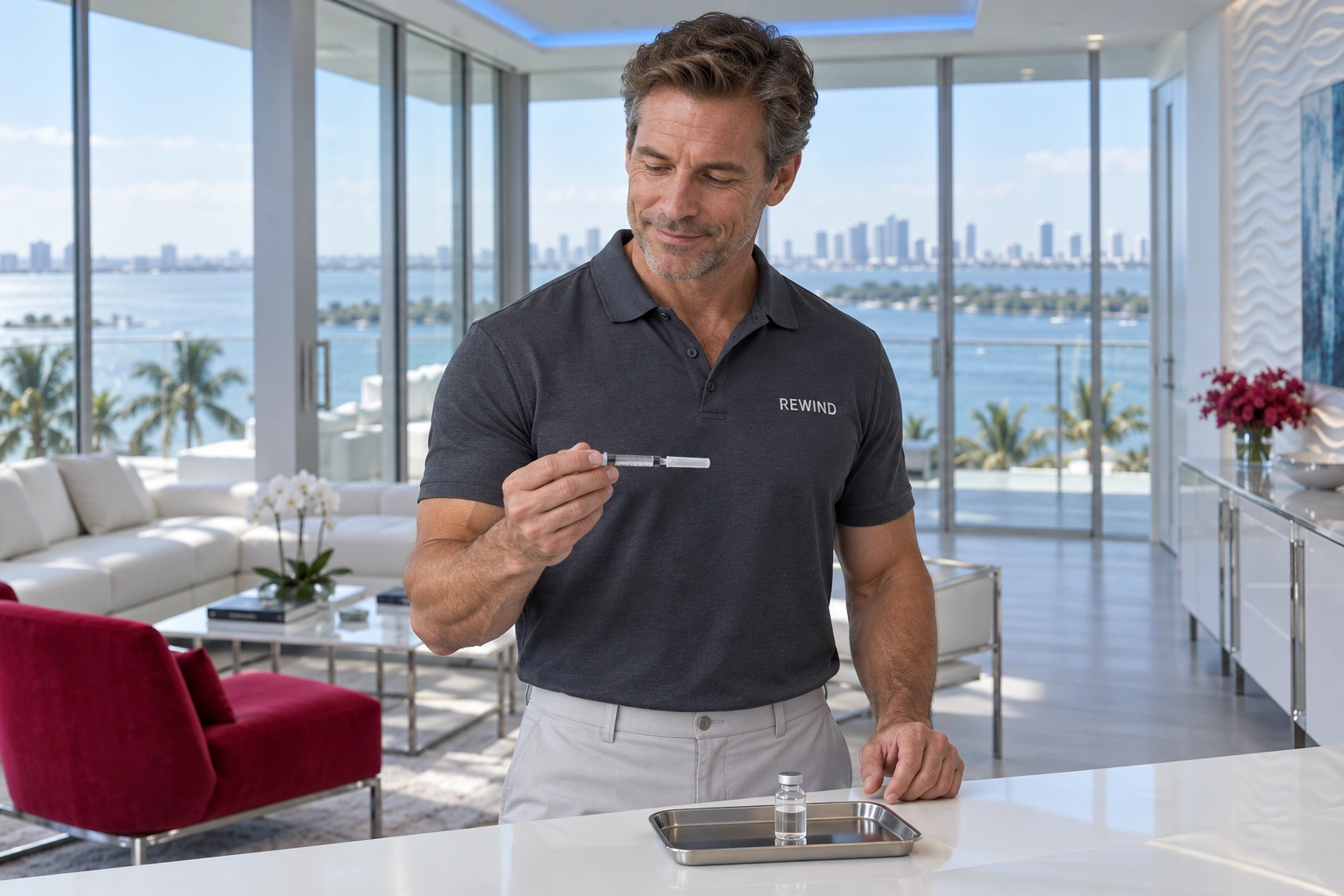
Testosterone injections at Rewind use testosterone cypionate, the most commonly used form of injectable testosterone in the United States. It is injected subcutaneously (into the fat, with a small needle) or intramuscularly, once or twice a week. Many patients self-inject at home after we train them in the office; others come in for their injections. Cypionate has a half-life of about eight days (2), which is what makes a weekly or twice-weekly schedule so stable.
Testosterone pellets vs injections at a glance

| Injections | Pellets | |
|---|---|---|
| How often | Once or twice a week, at home or in our office | Every 3 to 6 months, in office |
| Procedure | None; a small needle | Numbing, small incision, insertion |
| Changing the dose | Any week, from your labs | Up: another insertion. Down: removal, or wait for them to dissolve |
| Level pattern | Narrow band, a small rise and dip each week | Rise after insertion, drift down over months |
| Stopping | Skip the next injection | Wait for the pellets to dissolve, or have them removed |
| Cost | Least expensive route | Pellets plus a procedure fee each time |
| Recovery | None | Keep the site dry, skip hard lower-body training for several days |
Why injections: your dose can change any week
Nobody knows your ideal dose on day one. Two men with the same starting number can land in very different places, because how you absorb, convert and clear testosterone is individual. The first few months of therapy are about finding your dose, and that takes adjustment.
With injections, every follow-up lab can change the plan. At Rewind the first follow-up panel is at six to eight weeks, then every three to six months once you are stable. If your testosterone is lower than we want, the dose goes up. If estradiol or hematocrit is climbing, the dose comes down or the schedule is split. The change starts with your next injection and settles in over the following weeks.
With pellets, the dose is set when they go in. If it was too low, raising it takes another insertion procedure. If it was too high, the only ways to turn it down are surgical removal or waiting for the pellets to dissolve. That is the core reason we choose injections: it keeps you and your provider in control of the result.
Steady levels, week after week
Much of how you feel on testosterone depends on how steady your level is, not just how high it gets. Energy, mood, libido and sleep all respond to the pattern.
Weekly and twice-weekly injections keep levels in a narrow band. Because cypionate clears slowly, frequent smaller doses overlap, so the rise after each injection is small and the dip before the next is shallow. That is the reason to dose weekly or twice weekly rather than on the older every-two-weeks schedule, which is where the rollercoaster reputation of injections came from.
Pellets produce a different curve. Levels rise after insertion and drift down over the following months. Many people feel great in the middle of the cycle, and some notice fatigue or low libido creeping back toward the end, before the next insertion is due.
No procedure, no incision, nothing to recover from

A pellet insertion is minor, but it is still a procedure: a numbing injection, an incision, a trocar and a small dressing, repeated two to four times a year. Most clinics ask you to keep the site dry and skip hard lower-body training for several days afterward. Bleeding or bruising, infection at the insertion site and extrusion, where a pellet works its way back out through the skin, are recognized complications listed on the pellet label (1).
A subcutaneous injection is a small needle in the abdomen or thigh. It takes under a minute, you can train the same day, and it quickly becomes an ordinary part of the week. Our guide to your first 30 days on TRT walks through what that routine looks like.
Lower cost, and easy to stop
Injectable testosterone is the least expensive way to take testosterone, and there is no procedure fee tied to each dose. With pellets you pay for the pellets and the insertion every few months, whether or not the previous dose was right. Our breakdown of testosterone therapy cost covers what a full program includes. Rewind does not bill insurance, and HSA and FSA funds can be used.
Injections are also simple to stop. If your plans change, for example if fertility becomes a priority, you skip the next injection and levels fall back over the following couple of weeks. With pellets, testosterone keeps releasing until the pellets are gone. If fertility is on your mind now, ask about enclomiphene, which raises your own production instead of replacing it.
Your labs guide every change
Injections turn testosterone therapy into something you can steer with data. At Rewind, before anything is prescribed, a comprehensive baseline panel covers total and free testosterone, estradiol, SHBG, LH, FSH, a complete blood count, PSA, thyroid and metabolic markers. Follow-up labs at six to eight weeks and then every three to six months track testosterone, estradiol, hematocrit and PSA, and your dose follows them.
That feedback loop is where results come from. Libido typically improves in the first several weeks, and body composition, strength and mood build over three to six months as levels hold steady. Our article on TRT before and after describes what that timeline looks like in practice.
Where pellets appeal, and how injections answer it

The real draw of pellets is convenience: no weekly routine and nothing to remember. For some people that is worth a lot, and it is a fair preference.
For most patients, though, a one-minute injection once or twice a week is less of a commitment than it sounds, and it buys a dose that can be tuned to the result you want. A lot of reluctance about injections comes from the older picture of a large intramuscular shot every other week. A small subcutaneous injection on a steady weekly schedule is a different experience.
What about women?
Pellets are widely marketed to women too. Women need about a tenth of the testosterone a man does, and the right dose is a narrow target, which makes adjustability even more important. At Rewind, women receive low-dose testosterone as a topical cream, prescribed alongside estradiol and progesterone as part of female hormone replacement therapy, and adjusted from labs and symptoms the same way. Our article on whether women can take testosterone covers what it does and who it suits.
Starting testosterone injections at Rewind
Rewind Anti-Aging of Miami prescribes testosterone injections for men and does not offer pellets. Every plan starts with bloodwork, is dosed to your results, and is adjusted at every follow-up. The first step is a 30-minute discovery call, by video or in our Wynwood office, followed by a 60-minute consultation and your baseline labs. Learn more about our testosterone therapy program, or book your discovery call.
Sources
- Testopel (testosterone pellets) prescribing information. Endo Pharmaceuticals. DailyMed
- Depo-Testosterone (testosterone cypionate injection) prescribing information. Pfizer. DailyMed
- Bhasin S, Brito JP, Cunningham GR, et al. Testosterone Therapy in Men With Hypogonadism: An Endocrine Society Clinical Practice Guideline. J Clin Endocrinol Metab. 2018;103(5):1715–1744. PubMed
- Mulhall JP, Trost LW, Brannigan RE, et al. Evaluation and Management of Testosterone Deficiency: AUA Guideline. J Urol. 2018;200(2):423–432. PubMed
Frequently Asked Questions
Are testosterone pellets better than injections?
Both raise testosterone effectively, so the better choice comes down to control and convenience. Pellets trade control for fewer appointments: they last three to six months, but once they are in, the dose can only be raised with another insertion or lowered by removing them. Injections take about a minute once or twice a week, and in exchange your dose can be adjusted at any point from your labs. For most people starting therapy, when the right dose is not yet known, that adjustability matters more than the time saved.
Do testosterone injections keep levels steadier than pellets?
On a weekly or twice-weekly schedule, yes, in the way that matters day to day. Testosterone cypionate has a half-life of about eight days, so frequent smaller doses keep levels in a narrow band, with a small rise after each injection and a shallow dip before the next. Pellets rise after insertion and drift down over the following months, and some people feel symptoms returning before the next insertion is due.
Are testosterone injections cheaper than pellets?
Generally, yes. Injectable testosterone is the least expensive way to take testosterone, and there is no procedure fee attached to each dose. Pellets carry the cost of the pellets plus an in-office insertion every few months. Rewind does not bill insurance, and HSA and FSA funds can be used.
Do testosterone injections hurt?
A subcutaneous injection feels like a brief pinch. It uses a small, fine needle in the fat of the abdomen or thigh, takes under a minute, and we train you in the office until you are comfortable doing it yourself at home.
What if I am currently on pellets and want to switch to injections?
It is a common switch and a straightforward one. We check your labs and plan the first injection around where your current pellets are in their cycle, so levels hand over from one to the other rather than dipping. From there, dosing follows your follow-up bloodwork like any new start.
Does Rewind offer hormone pellets?
No. Rewind prescribes testosterone as injections for men and as a low-dose cream for women, because both can be adjusted as your labs and symptoms change. A 30-minute discovery call, by video or in our Wynwood office, is the easiest way to talk through which fits you.
More in hormones
How Long Does HRT Take to Work? A Real Timeline
How long does HRT take to work depends on the symptom. Hot flashes shift in weeks, libido in months, bone density in a year. A symptom-by-symptom timeline.
hormonesEnclomiphene vs TRT: Which One Preserves Fertility
Enclomiphene vs TRT: both normalize testosterone, but only one raises LH and FSH and protects sperm production. What the trials show and who each option suits.
hormonesCortisol Belly: What Testing Shows and What Works
Cortisol belly is a real mechanism and an overused explanation. Here is what cortisol testing actually shows, what moves midsection fat, and how long it takes.
⚕ Medical Disclaimer
The information on this page is for educational purposes only and does not constitute medical advice, diagnosis, or treatment. All treatments at Rewind Anti-Aging of Miami are performed under the supervision of licensed medical professionals. Individual results may vary. Consult your physician before beginning any new treatment protocol.
Meet our clinical team →Not sure which treatment is right for you?
Take our free 2-minute assessment and get a personalized recommendation.
Areas We Serve in Miami & South Florida
Our clinic at 24 NW 29th Street is in Wynwood & Midtown, minutes from Edgewater and Brickell. We also care for patients across Coral Gables, Aventura, Key Biscayne, and Doral — plus the entire state of Florida via telehealth.
Take the Next Step
Our team at Rewind Anti-Aging in Miami is here to help you determine if enclomiphene therapy is right for your goals.