

Men starting testosterone therapy are usually told about the benefits and the monitoring, and much less often about the one decision that is far easier to get right at the start than to fix later. hCG with TRT is that decision.
The reason it matters is mechanical. Testosterone replacement works by supplying testosterone from outside, and the body responds exactly as you would expect: it stops making its own. That shutdown affects more than a lab number. It affects sperm production, testicular volume, and — for a subset of men — how they feel on therapy. hCG prevents most of it, costs one extra injection, and takes about ninety seconds a week.
This article covers what hCG actually does, what the evidence supports, how it is dosed and monitored, what it does not fix, and what your options are if you are already suppressed.
Why TRT Suppresses the Testes in the First Place
The hypothalamic-pituitary-gonadal axis is a thermostat. The hypothalamus releases GnRH in pulses; the pituitary responds with luteinizing hormone (LH) and follicle-stimulating hormone (FSH); LH acts on Leydig cells in the testes to produce testosterone, and FSH acts on Sertoli cells to support sperm maturation. Circulating testosterone feeds back to the hypothalamus and pituitary and turns the signal down.
Introduce testosterone from outside and the feedback loop reads it as abundance. GnRH pulses slow, LH and FSH fall toward undetectable, and the testes stop being told to do anything.
Two consequences follow, and only one of them shows up on a standard panel.
The visible one: testicular volume decreases. Leydig and Sertoli cells that are not being stimulated shrink. Most men notice this within a few months.
The one that matters more: intratesticular testosterone collapses. The concentration of testosterone inside the testis is roughly a hundred times higher than in blood, and spermatogenesis depends on that local concentration, not on your serum level. In a controlled study, healthy men given suppressive testosterone showed intratesticular testosterone fall by approximately 94 percent (1). Your serum testosterone can read 900 ng/dL while the environment sperm production requires has essentially gone.
This is why a man can feel excellent on TRT, have textbook labs, and be functionally infertile. The panel does not measure the compartment that changed.
What hCG With TRT Actually Does
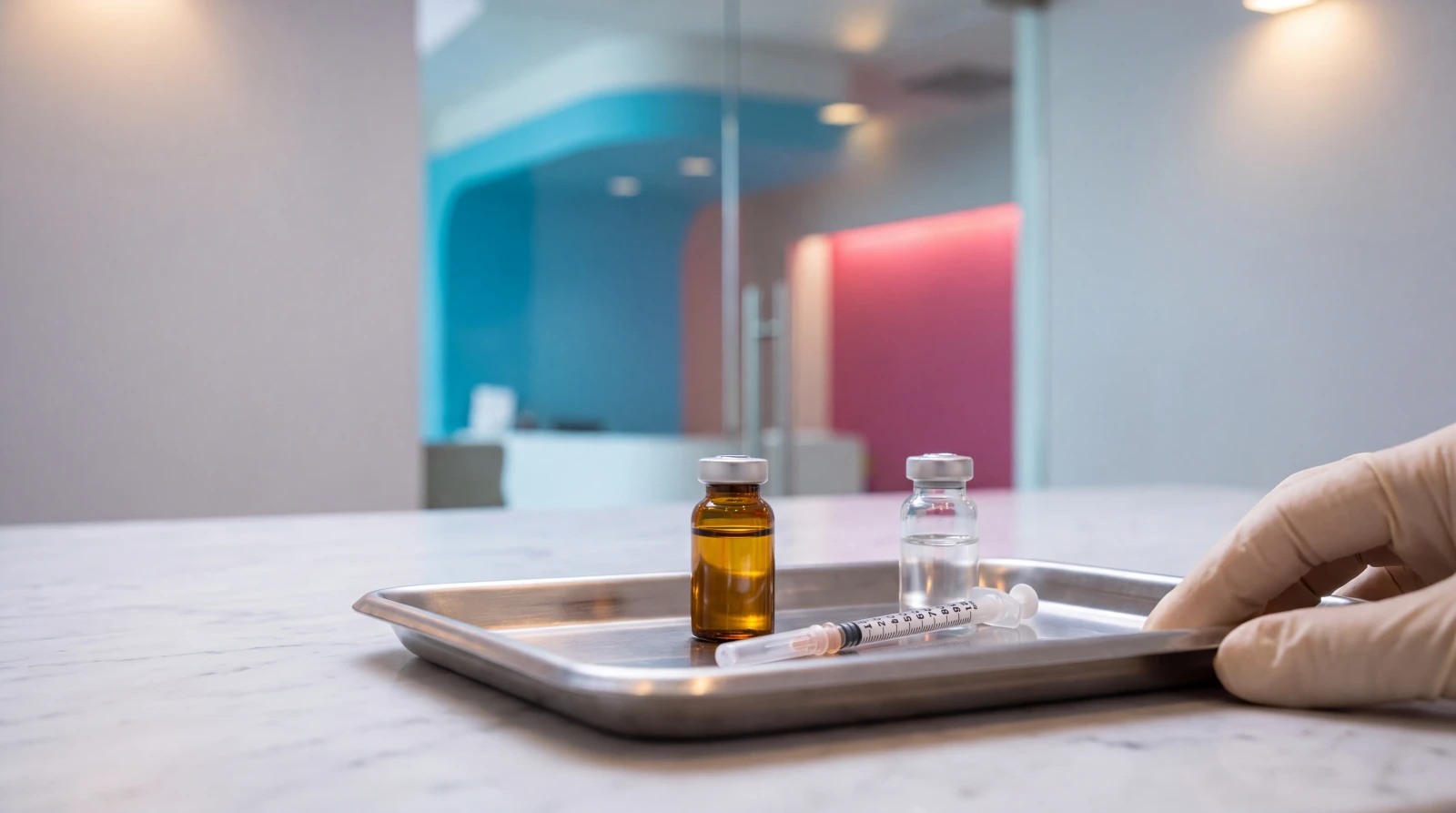
Human chorionic gonadotropin is structurally similar enough to LH that it binds the same LH/hCG receptor on the Leydig cell — and it does so with a considerably longer half-life, which is why it is dosed a few times a week rather than in pulses.
From the testis’s point of view, hCG looks like the LH signal that TRT has switched off. The Leydig cells keep working. Intratesticular testosterone is maintained. Testicular volume is largely preserved.
The key evidence here is a dose-ranging trial in which healthy men received suppressive testosterone plus one of three low hCG doses. Intratesticular testosterone was measured directly. The result was dose-dependent maintenance: 250 IU every other day held intratesticular testosterone at close to baseline, with lower doses producing partial maintenance (1). That study is the reason low-dose hCG alongside TRT is standard practice rather than a theory.
What hCG does not replace is FSH. Spermatogenesis needs both the intratesticular androgen environment and FSH signalling to Sertoli cells. For most men on TRT with hCG, endogenous FSH suppression plus a maintained intratesticular environment is enough to keep sperm production going. For some — particularly men with pre-existing impairment or a longer suppression history — recombinant FSH or hMG is added. That is a decision made from a semen analysis, not from a protocol.
What You Can Expect From Adding It
Realistic outcomes, in rough order of reliability.
Intratesticular testosterone maintained. The best-supported effect, demonstrated directly by measurement (1).
Testicular volume preserved. Men who start hCG alongside TRT generally do not experience the shrinkage that TRT alone produces. Men who add it after months of suppression typically recover a good deal of volume over eight to twelve weeks, though not always all of it.
Fertility preserved in most men. Cohort data on men maintained on testosterone with concurrent low-dose hCG report preservation of semen parameters over extended follow-up (2). “Most” is the honest word. If you are actively trying to conceive, the semen analysis is the measurement, not the protocol.
Subjective wellbeing, in some men. A subset consistently report feeling better on TRT with hCG than on TRT alone — libido, mood, and a less “flat” quality to the response. The mechanism is debated and plausibly involves the other steroids the testis produces alongside testosterone, including pregnenolone and DHEA, which exogenous testosterone does not supply. The evidence here is weaker than for the first three, and it is fair to describe it as a common clinical observation rather than a proven effect.
Timeline. If you start together, there is nothing to wait for — you are preventing a change rather than reversing one. If you are adding hCG to established TRT, expect testicular volume to respond over roughly eight to twelve weeks and semen parameters, where they recover, to take longer.

Dosing and Monitoring
Dosing should come from your prescriber. What follows is the structure of the decision, not a protocol to copy.
The usual range in practice is a few hundred international units, subcutaneously, two or three times per week, timed alongside the testosterone injections. The dose-ranging data supports 250 IU every other day as a level that maintains intratesticular testosterone near baseline (1), and many clinicians work around that figure, adjusting for goals — fertility preservation, volume maintenance, or symptom response.
Route and handling. Subcutaneous with an insulin syringe. hCG is supplied as a lyophilised powder reconstituted with bacteriostatic water, refrigerated after mixing, and used within the stability window the pharmacy specifies. Getting the reconstitution arithmetic right matters — this is a common source of accidental over- and under-dosing, and it is worth having someone walk you through it once.
What gets monitored, and why:
| Marker | Why | When |
|---|---|---|
| Total and free testosterone | Adding hCG raises total testosterone; the TRT dose often needs reducing | 6–8 weeks after starting, then routinely |
| Estradiol (sensitive assay) | hCG drives Leydig cell output, and more substrate means more aromatisation | 6–8 weeks, then routinely |
| Hematocrit | Erythrocytosis is the most common dose-limiting effect of androgen therapy generally | Every 3–6 months |
| Semen analysis | The only actual measure of fertility. Nothing else substitutes | Baseline if fertility matters, then as indicated |
| Testicular volume | Clinical exam, or an orchidometer | Baseline and periodically |
| PSA | Standard androgen therapy monitoring in men over 40 | Baseline, then annually |
The estradiol row is where most adjustment happens. Adding hCG frequently raises estradiol more than TRT alone, and the reflex to reach for an aromatase inhibitor should be resisted as a first move. Estradiol is not a nuisance hormone in men — it is required for bone density, lipid handling, joint comfort and libido, and crushing it causes a recognisable and unpleasant syndrome. Reducing the hCG dose, or the testosterone dose, is usually the better lever.
hCG Versus the Alternatives
Several drugs occupy adjacent territory, and they are not interchangeable.
| Option | Where it acts | Best suited to |
|---|---|---|
| hCG alongside TRT | Directly on the Leydig cell, replacing the LH signal | Men on TRT who want to preserve fertility, volume, or both |
| hCG monotherapy | Same, without exogenous testosterone | Younger men with secondary hypogonadism who want to avoid suppression entirely |
| Enclomiphene | Blocks estrogen feedback at the hypothalamus and pituitary, raising the man’s own LH and FSH | Secondary hypogonadism with a responsive pituitary and intact testicular function |
| hMG or recombinant FSH | Supplies the FSH signal | Added when semen parameters remain poor despite an adequate intratesticular environment |
| Aromatase inhibitor | Blocks conversion of testosterone to estradiol | Documented, symptomatic elevated estradiol — not routine prophylaxis |
The genuinely important distinction is between working on the testis and working above it. hCG replaces the pituitary signal. Enclomiphene tries to restore it. If the pituitary is the problem, enclomiphene can work and preserves the whole axis — we cover it under enclomiphene. If the testis is the problem, no amount of upstream signalling helps and replacement is the answer.
If You Are Already Suppressed
Plenty of men arrive having been on TRT for years with no hCG, and now want children. This is a solvable problem, and it is a slower one.
Off testosterone entirely, sperm return in a median of around six months, with most men recovering within one to two years. Recovery is slower with longer duration of use, higher doses and increasing age (3). Anabolic steroid use at supraphysiologic doses extends it further.
Structured restart protocols shorten that for many men. The usual shape is hCG to restart Leydig cell function, frequently with a SERM such as clomiphene or tamoxifen to lift the pituitary, and FSH or hMG added if semen parameters lag. This is managed against serial semen analyses, and it takes months rather than weeks.
Some men stay on TRT and add hCG rather than coming off. Whether that is sufficient depends on how long suppression has run and what the semen analysis shows. It is worth attempting before accepting a full stop.
Two things worth saying plainly. First, recovery is likely but not certain, and a small number of men do not recover fully. Second, none of this is an argument against TRT — it is an argument for making the fertility decision deliberately at the start, when it costs almost nothing.
The Supply Question
Men who have been on TRT for years often notice hCG became harder and more expensive to obtain, and it is worth explaining rather than leaving as a mystery.
In March 2020, chorionic gonadotropin was among the protein products transitioned from regulation as drugs to regulation as biologics under the Biologics Price Competition and Innovation Act. Biologics are not eligible for compounding under sections 503A and 503B of the Food, Drug, and Cosmetic Act, which removed compounded hCG — the low-cost route most men on TRT had been using — from the market (4).
FDA-approved chorionic gonadotropin products remain available by prescription, and that is now the route. Expect a higher cost than the compounded product carried, and expect to source it through a pharmacy that stocks the approved product.
What hCG Does Not Fix
Worth being explicit, because expectations drift.
It does not make TRT unnecessary. hCG maintains the testis’s ability to respond, but in a man with genuinely low production it does not by itself reach the serum levels replacement therapy is aiming for. Monotherapy is a real option in a specific group — younger men with secondary hypogonadism and responsive testes — and it is not a general substitute.
It does not protect against erythrocytosis. Rising hematocrit is driven by androgen exposure overall, and adding hCG raises total androgen output rather than lowering it. If anything, hematocrit needs watching a little more closely, not less.
It does not guarantee a sperm count. The intratesticular environment is a necessary condition, not a sufficient one. Pre-existing varicocele, prior chemotherapy, genetic factors and simple bad luck all still apply. The semen analysis is the measurement.
It does not correct a diagnosis that was never made. A man put on TRT for fatigue without a proper workup — two morning total testosterone measurements, free testosterone, SHBG, LH, FSH, prolactin, a thyroid panel and an iron study — may be treating the wrong thing regardless of what else is added to the protocol.
Common Mistakes
The errors we see most, in rough order of frequency.
Waiting. By far the most common. hCG gets discussed at the two-year mark, prompted by a change in life plans, when it could have been a line on the first prescription. Nothing else on this list costs as much.
Reconstitution arithmetic. hCG arrives as a powder and the delivered dose depends entirely on how much bacteriostatic water it was mixed with. Getting this wrong by a factor of two or four is easy and common, and it is the source of both non-response and unexpectedly high estradiol. Have someone check your maths the first time.
Chasing estradiol with an aromatase inhibitor. Adding hCG raises estradiol, and the temptation to add an aromatase inhibitor immediately is strong. Suppressed estradiol in men produces joint pain, low libido, low mood and adverse effects on bone density — frequently mistaken for the testosterone dose being too low, which leads to raising it, which makes everything worse. Adjust the hCG or testosterone dose first, and treat estradiol only when it is both elevated and symptomatic.
Dosing too high. More hCG is not better. Excessive or continuous high-dose stimulation can desensitise the Leydig cell receptor, which is the opposite of the goal. Low and regular beats high and occasional.
Skipping the baseline semen analysis. If fertility is part of why you are adding hCG, a baseline before starting is what makes every later result interpretable. Without it, a mediocre count at month twelve cannot be attributed to anything.
Who Should Be Having This Conversation
Definitely:
- Any man under 45 starting TRT, whether or not children are currently in the plan. Plans change, and this is the cheapest insurance available.
- Any man who has not completed his family.
- Any man who cares about testicular volume, which is a legitimate consideration and not a vain one.
- Men who feel incompletely well on TRT alone despite good numbers.
Possibly not:
- Men who have completed their families, have no volume concerns and feel well. hCG is optional here, and adding an injection with no goal attached is not automatically better.
- Men with primary testicular failure, where the Leydig cells cannot respond regardless of the signal. Worth establishing before starting, not after.
If you are earlier in the process, first 30 days on TRT covers what starting actually feels like, and TRT before and after sets realistic expectations on the timeline. The full workup sits under testosterone therapy.
The Practical Summary
hCG with TRT is not an add-on for enthusiasts. It is the standard answer to a predictable consequence of testosterone replacement, and the whole calculation turns on timing: preventing suppression is easy, reversing it is not.
If fertility, testicular volume or the completeness of your response to therapy matter to you, the conversation belongs at the first appointment — before the first injection, ideally with a baseline semen analysis in hand if children are anywhere in the plan.
Starting TRT, or already on it and want the fertility side handled properly? Book a consult with our Miami team.
Medical disclaimer: This article is for educational purposes only and is not a substitute for professional medical advice, diagnosis, or treatment. Dosing ranges described here are drawn from published literature and clinical practice and are not a prescription. Consult a qualified clinician before starting or changing hormone therapy.
Sources
- Coviello AD, Matsumoto AM, Bremner WJ, et al. Low-dose human chorionic gonadotropin maintains intratesticular testosterone in normal men with testosterone-induced gonadotropin suppression. The Journal of Clinical Endocrinology & Metabolism. 2005;90(5):2595–2602.
- Hsieh TC, Pastuszak AW, Hwang K, Lipshultz LI. Concomitant intramuscular human chorionic gonadotropin preserves spermatogenesis in men undergoing testosterone replacement therapy. The Journal of Urology. 2013;189(2):647–650.
- Liu PY, Swerdloff RS, Christenson PD, et al. Rate, extent, and modifiers of spermatogenic recovery after hormonal male contraception: an integrated analysis. The Lancet. 2006;367(9520):1412–1420.
- U.S. Food and Drug Administration. The “Deemed to be a License” Provision of the BPCI Act: Questions and Answers. Guidance for Industry.
- Mulhall JP, Trost LW, Brannigan RE, et al. Evaluation and Management of Testosterone Deficiency: AUA Guideline. The Journal of Urology. 2018;200(2):423–432.
- Wenker EP, Dupree JM, Langille GM, et al. The Use of HCG-Based Combination Therapy for Recovery of Spermatogenesis after Testosterone Use. The Journal of Sexual Medicine. 2015;12(6):1334–1337.
Frequently Asked Questions
Does hCG with TRT actually preserve fertility?
It substantially improves the odds, and the mechanism is well understood, but no protocol guarantees fertility. Testosterone therapy suppresses LH and FSH, and intratesticular testosterone falls by roughly 94 percent within weeks — the local concentration sperm production depends on. hCG binds the same Leydig cell receptor as LH and maintains that intratesticular concentration, which has been demonstrated in a dose-ranging trial. Men actively trying to conceive should have a semen analysis rather than relying on the protocol alone.
Should I start hCG at the same time as TRT or add it later?
At the same time, in almost every case where fertility or testicular volume matters to you. Preventing suppression is straightforward; reversing it takes months of a restart protocol with no guaranteed outcome. The cost of adding hCG at the start is a second injection and slightly more monitoring. The cost of adding it after two years of suppression is a considerably harder problem.
What dose of hCG is used with TRT?
The most commonly used range in clinical practice is a few hundred international units two or three times a week, given subcutaneously alongside the testosterone. A dose-ranging study found that 250 IU every other day maintained intratesticular testosterone at close to baseline in men receiving suppressive testosterone, with lower doses producing partial maintenance. Your dose should be set by your prescriber against your labs, symptoms and goals, not copied from a protocol online.
Does hCG raise estrogen?
It can. hCG stimulates Leydig cells, and Leydig cells produce testosterone that is then aromatised to estradiol, so adding hCG on top of TRT often raises estradiol more than TRT alone would. This is manageable and is the main reason estradiol is monitored after starting it. The answer is usually a dose adjustment rather than automatically adding an aromatase inhibitor — over-suppressing estradiol causes its own problems, including joint pain, low libido and adverse effects on bone.
Why is hCG harder to get than it used to be?
In March 2020 chorionic gonadotropin was transitioned from regulation as a drug to regulation as a biologic under the Biologics Price Competition and Innovation Act. Biologics are not eligible for compounding under sections 503A and 503B, so compounding pharmacies can no longer supply hCG, which had been the low-cost route for most men on TRT. FDA-approved chorionic gonadotropin products remain available by prescription, and that is now the route.
How long does it take for fertility to recover if I stop TRT?
Median time to return of sperm in the ejaculate after stopping exogenous testosterone is commonly reported at around six months, with the large majority of men recovering within twelve to twenty-four months. Recovery is slower with longer duration of use, higher doses and older age. Structured restart protocols using hCG, sometimes with a SERM and occasionally with FSH, shorten that timeline for many men — which is exactly why not suppressing in the first place is the better plan.
More in hormones
Cortisol Belly: What Testing Shows and What Works
Cortisol belly is a real mechanism and an overused explanation. Here is what cortisol testing actually shows, what moves midsection fat, and how long it takes.
hormonesHow to Choose a TRT Clinic in Miami: 8 Questions to Ask
How to choose a TRT clinic in Miami: eight questions about labs, monitoring, fertility, pricing and follow-up that separate a real testosterone program from a prescription mill.
hormonesStarting Hormone Therapy in Miami: First Visit to First Prescription
Starting hormone therapy in Miami, step by step: the consultation, body scan and blood panel, the results review, your prescription, and the first follow-up labs.
⚕ Medical Disclaimer
The information on this page is for educational purposes only and does not constitute medical advice, diagnosis, or treatment. All treatments at Rewind Anti-Aging of Miami are performed under the supervision of licensed medical professionals. Individual results may vary. Consult your physician before beginning any new treatment protocol.
Meet our clinical team →Not sure which treatment is right for you?
Take our free 2-minute assessment and get a personalized recommendation.
Areas We Serve in Miami & South Florida
Our clinic at 24 NW 29th Street is in Wynwood & Midtown, minutes from Edgewater and Brickell. We also care for patients across Coral Gables, Aventura, Key Biscayne, and Doral — plus the entire state of Florida via telehealth.
Take the Next Step
Our team at Rewind Anti-Aging in Miami is here to help you determine if testosterone therapy is right for your goals.