

The most discussed sauna benefits for longevity come down to a simple, hopeful pattern in the research: people who sweat it out in a sauna several times a week tend to live longer and have fewer cardiovascular events than people who rarely use one. The strongest evidence comes from long-running Finnish population studies that followed thousands of middle-aged men for decades (1). These findings are associations, not proof — but they are striking enough that heat exposure has earned a real place in the longevity conversation alongside exercise, sleep, and diet. Below we walk through what the data actually show, the biology that may explain it, a practical dose guide, and the safety rules that matter.
The Finnish cohort studies on sauna benefits
Much of the modern interest traces back to the Kuopio Ischaemic Heart Disease Risk Factor Study (KIHD), a prospective cohort based in eastern Finland — a country where sauna use is woven into daily life. Researchers led by Jari Laukkanen followed roughly 2,300 middle-aged men and tracked how often and how long they used a traditional sauna, then watched health outcomes over a median of about 20 years (1).
The headline result: compared with men who used a sauna once per week, those who went 4–7 times per week had a substantially lower risk of fatal cardiovascular events and lower all-cause mortality over the follow-up period (1). A 2–3 times-per-week group fell in between. Longer individual sessions (more than ~19 minutes) were also associated with lower risk than very short ones. Later analyses from the same group reported associations between frequent sauna bathing and lower incidence of stroke (2) and even lower risk of being diagnosed with dementia and Alzheimer’s disease (3).
It is worth being clear-eyed about what this is and isn’t. These are observational findings. Men who use a sauna four to seven times a week may simply be healthier, wealthier, less stressed, more physically active, or more socially connected than men who don’t — and those factors, not the heat itself, could drive part of the benefit. The researchers adjusted for many known confounders, but observational studies cannot fully rule out residual confounding or reverse causation. No large randomized controlled trial has tested whether starting a sauna habit extends lifespan. So the honest summary is: frequent sauna use is associated with better cardiovascular and longevity outcomes, and the relationship looks dose-dependent, but causation is not established.
Why heat might help: heat-shock proteins and hormesis

If the association is real, what could explain it? Several plausible mechanisms have been proposed, and most center on the idea of hormesis — a mild, controlled stressor that triggers adaptive, protective responses in the body.
Heat-shock proteins
When tissue temperature rises, cells ramp up production of heat-shock proteins (HSPs), a family of molecular chaperones that help other proteins fold correctly, repair damaged proteins, and prevent harmful protein clumping (4). Because the accumulation of misfolded and aggregated proteins is a feature of aging and several age-related diseases, a system that keeps protein quality high is biologically attractive. Repeated heat exposure appears to upregulate HSPs, and researchers have hypothesized this as one pathway linking sauna use to healthier aging (4). This remains a mechanistic hypothesis rather than proven cause-and-effect in humans.
Cardiovascular conditioning
A sauna session is, in cardiovascular terms, a little like light-to-moderate exercise. Heat raises heart rate (often to 100–150 beats per minute), dilates blood vessels, and lowers blood pressure during and after the session (1)(5). Regular exposure has been associated with improved endothelial function (the health of the blood-vessel lining), reduced arterial stiffness, and modest reductions in blood pressure over time (5). These are the same directions of change we want from aerobic training, which is part of why some researchers describe sauna as “passive cardiovascular conditioning.”
Other proposed pathways
Heat exposure may also influence inflammation, autonomic nervous-system balance, and the release of nitric oxide. Many people also report better sleep and stress relief, both of which matter for long-term health. These mechanisms are biologically reasonable and supported by smaller studies, but they don’t yet prove that sauna use causes longer life — they describe how it could.
A practical sauna dose guide
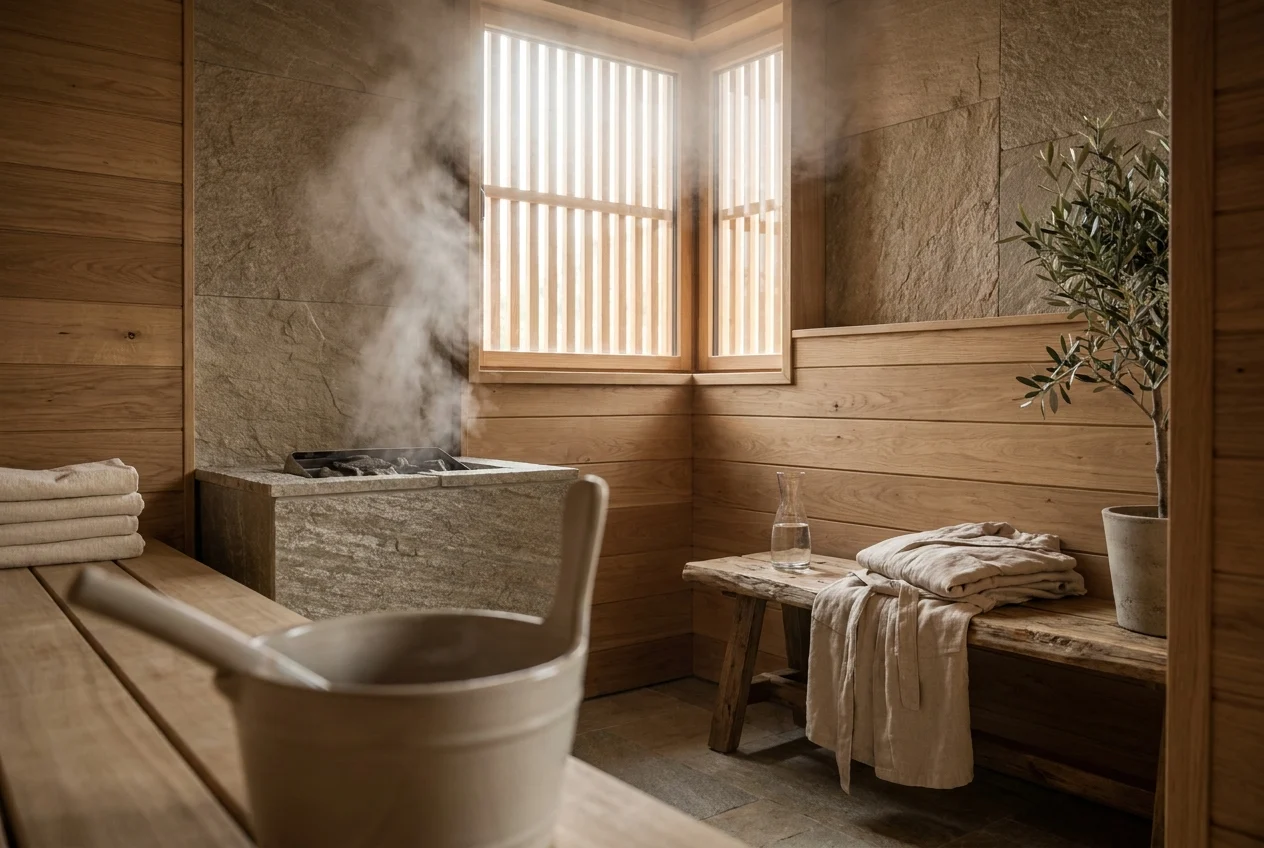
There is no certified “optimal prescription,” and the ranges below simply reflect what was studied in the Finnish cohorts plus general practice. Treat this as a starting framework to discuss with your clinician, not a rule.
| Variable | General range studied / used | Notes |
|---|---|---|
| Frequency | 2–7 sessions per week | Strongest associations at 4–7×/week; 2–3×/week still associated with benefit (1) |
| Duration | ~15–20 minutes per session | Sessions over ~19 min were associated with lower risk than very short ones (1) |
| Temperature | ~80–100°C (176–212°F) | Traditional dry Finnish sauna at bather level; infrared runs cooler and is less studied |
| Cool-down | 5–10 minutes between rounds | Hydrate, rest, let heart rate settle before any additional round |
| Build-up | Start low and short | New users should begin with shorter, cooler sessions and progress gradually |
Infrared saunas, which are common in U.S. wellness settings, operate at lower temperatures and have not been studied the way traditional Finnish saunas have, so the longevity data above should not be assumed to transfer directly to them.
How to use a sauna safely
The same heat stress that may drive benefits also creates real risk if handled carelessly. A few practical safety points:
- Hydrate. You lose meaningful fluid through sweat. Drink water before and after, and don’t push through dizziness or lightheadedness.
- Skip the alcohol. Combining alcohol with sauna heat raises the risk of dehydration, dangerously low blood pressure, arrhythmia, and sudden cardiac events. Finnish public-health guidance has long warned against it.
- Cardiac caution. Sauna raises heart rate and lowers blood pressure. People with unstable angina, a recent heart attack, severe aortic stenosis, or poorly controlled arrhythmias should not use a sauna without explicit physician clearance (5).
- Pregnancy. Pregnant women should consult their obstetrician before any sauna or hot-tub use, particularly early in pregnancy, because raising core body temperature may carry risk to the developing baby.
- Listen to your body. Exit if you feel faint, nauseated, or your heart rate feels irregular. Don’t use a sauna alone if you have any condition that could cause you to lose consciousness, and avoid sauna immediately after intense exercise without a cool-down.
Used sensibly, sauna is generally well tolerated by healthy adults — but “generally” is doing real work in that sentence, and individual circumstances vary.
Where sauna fits in a longevity plan

Sauna is best understood as one lever among many, not a standalone fountain of youth. The people in the Finnish studies who benefited most were embedded in a culture of regular movement, social connection, and consistent heat exposure. At Rewind, we think about heat the way we think about exercise, sleep, nutrition, and — where clinically appropriate — hormone optimization: complementary inputs that compound over time. If you’re building a broader strategy, see our longevity protocol, and our companion guides on how to slow biological aging and anti-aging in your 50s.
The bottom line: the sauna-and-longevity evidence is encouraging and biologically plausible, but it rests on observational associations rather than proof. If you enjoy the heat and your cardiovascular status allows it, a regular sauna habit is a low-cost, low-tech addition to a healthy life. As with anything that stresses the cardiovascular system, the smart move is to personalize it.
If you’d like help fitting heat exposure into a comprehensive, lab-guided longevity plan, the team at Rewind Anti-Aging of Miami offers longevity consultations — book a longevity consult to talk through what makes sense for you.
Medical disclaimer: This article is for general educational purposes only and is not a substitute for personalized medical advice; consult your physician before starting sauna use, especially if you have a heart condition or are pregnant.
Sources
- Laukkanen T, Khan H, Zaccardi F, Laukkanen JA. Association between sauna bathing and fatal cardiovascular and all-cause mortality events. JAMA Internal Medicine. 2015;175(4):542–548.
- Kunutsor SK, Khan H, Zaccardi F, Laukkanen T, Willeit P, Laukkanen JA. Sauna bathing reduces the risk of stroke in Finnish men and women: a prospective cohort study. Neurology. 2018;90(22):e1937–e1944.
- Laukkanen T, Kunutsor S, Kauhanen J, Laukkanen JA. Sauna bathing is inversely associated with dementia and Alzheimer’s disease in middle-aged Finnish men. Age and Ageing. 2017;46(2):245–249.
- Patrick RP, Johnson TL. Sauna use as a lifestyle practice to extend healthspan. Experimental Gerontology. 2021;154:111509.
- Laukkanen JA, Laukkanen T, Kunutsor SK. Cardiovascular and other health benefits of sauna bathing: a review of the evidence. Mayo Clinic Proceedings. 2018;93(8):1111–1121.
Frequently Asked Questions
How often should you use a sauna?
In the Finnish observational studies, the largest mortality associations were seen with 4–7 sessions per week of roughly 15–20 minutes each. Two to three sessions weekly were also associated with benefit versus once weekly. There is no proven optimal dose, and any routine should fit your health status and physician guidance.
What temperature should a sauna be for these benefits?
The Finnish data come mostly from traditional dry saunas around 80–100°C (176–212°F) at the bather's level. Infrared saunas run cooler (45–60°C / 113–140°F) and have not been studied the same way, so the longevity evidence does not transfer directly.
Are sauna benefits proven to extend lifespan?
No. The strongest data are observational cohort studies showing association, not proof of cause. Frequent sauna users may differ from infrequent users in fitness, income, and health behaviors. Randomized long-term mortality trials do not exist.
Is sauna use safe if I have heart disease?
Sauna raises heart rate and lowers blood pressure, which can be a problem with unstable angina, recent heart attack, severe aortic stenosis, or uncontrolled arrhythmias. Anyone with cardiac disease should clear sauna use with their physician first.
Can you use a sauna while pregnant?
Pregnant women should be cautious and consult their obstetrician before any sauna or heat exposure, especially in the first trimester, because elevated core body temperature carries potential risk. This is not individual medical advice.
Does drinking alcohol in the sauna increase risk?
Yes. Combining alcohol with sauna heat raises the risk of dehydration, low blood pressure, arrhythmia, and sudden cardiac events. Alcohol before or during a sauna session is strongly discouraged.
More in wellness
Comprehensive Lab Panel Miami: What Rewind Tests and Why
What a comprehensive lab panel should include beyond a standard physical — 30+ biomarkers across hormones, thyroid, metabolic health, and inflammation.
wellnessThe Rewind Anti-Aging Story: Why We Built This Clinic
The Rewind Anti-Aging story starts with a failing engineer in his mid-40s — and the gap in care that turned a personal fix into a Miami practice.
wellnessSnowbird Wellness Miami: Care That Travels With You
How seasonal residents keep hormone therapy, labs, and longevity care continuous across two states — and what to set up before you fly south or north.
⚕ Medical Disclaimer
The information on this page is for educational purposes only and does not constitute medical advice, diagnosis, or treatment. All treatments at Rewind Anti-Aging of Miami are performed under the supervision of licensed medical professionals. Individual results may vary. Consult your physician before beginning any new treatment protocol.
Meet our clinical team →Not sure which treatment is right for you?
Take our free 2-minute assessment and get a personalized recommendation.
Areas We Serve in Miami & South Florida
Our clinic at 24 NW 29th Street is in Wynwood & Midtown, minutes from Edgewater and Brickell. We also care for patients across Coral Gables, Aventura, Key Biscayne, and Doral — plus the entire state of Florida via telehealth.
Take the Next Step
Our team at Rewind Anti-Aging in Miami is here to help you determine if the Rewind Longevity Protocol is right for your goals.