
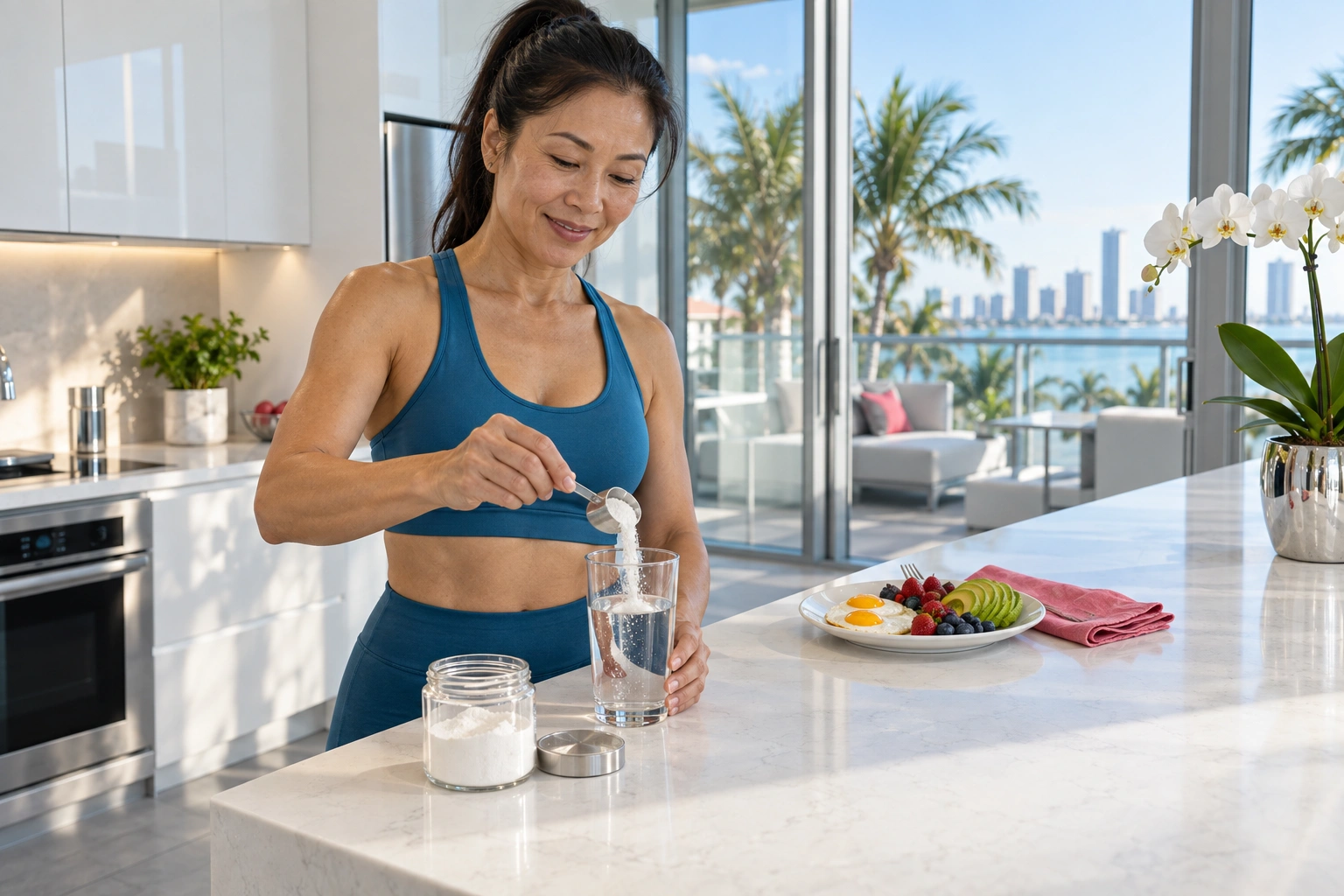
Creatine has spent thirty years being marketed to twenty-year-old men, which is roughly the opposite of the population with the most to gain from it. The research on creatine and menopause points somewhere more specific: the menopause transition is when women lose lean mass and bone density fastest, and it is also the window in which creatine paired with resistance training has its most supportive data.
That framing matters, because it also defines the limit. Creatine is not a menopause treatment. It will not touch a hot flash. What it does is make resistance training more productive at exactly the point in life when resistance training is doing the most important work.
Why the Menopause Transition Changes the Math
Estrogen is not only a reproductive hormone. It has direct effects on muscle and bone, and its decline is why the musculoskeletal changes of midlife arrive faster than ordinary aging would predict.
Through perimenopause and the first years after the final menstrual period, bone loss accelerates sharply compared with the preceding decade, and lean mass declines while fat mass tends to redistribute toward the abdomen. The result is frequently a stable number on the scale hiding a genuine change underneath it — which is why body composition is a more useful measurement than weight during this window. Our women’s body fat percentage chart covers what those ranges look like.
Two things reliably push back on that trajectory: loading the muscle and skeleton, and giving the muscle enough substrate to adapt. Creatine sits squarely in the second category.
How Creatine Works, Briefly

Creatine is stored in muscle as phosphocreatine, which regenerates ATP during short, intense effort. Practically, this means a few extra repetitions at a given load, slightly better performance on the last set, and a faster return between sets.
That is a small per-session effect. The reason it matters over months is that training adaptation is cumulative: modestly more total work per session, repeated across a year of consistent lifting, compounds into a measurably different outcome. Creatine does not build muscle. It lets training build more of it.
Creatine is also present in the brain, and supplementation raises brain creatine content by roughly 5 to 15 percent (1) — which is the mechanistic basis for the cognitive findings discussed further down.
What Creatine and Menopause Research Actually Shows
The postmenopausal literature is more specific than the general creatine literature, and it is worth separating what has been demonstrated from what is extrapolated.
Lean mass and strength. A systematic review and meta-analysis of creatine monohydrate in postmenopausal women found improvements in lean mass and in both upper- and lower-body strength when creatine was combined with resistance training (2). The effects are consistent in direction and moderate in size — meaningful over a year, not transformative in a month.
Bone density. This is the most interesting finding and the one most often overstated. In a two-year double-blind randomized controlled trial, postmenopausal women performing resistance training three days per week took either creatine at 0.1 g per kilogram per day or placebo. Twelve months of creatine during resistance training preserved femoral neck bone mineral density and increased femoral shaft periosteal width, a predictor of bone bending strength (3).
Read that precisely. Creatine preserved hip bone density relative to placebo and widened the bone shaft; it did not broadly increase bone density across every site measured. Preservation at the femoral neck is nonetheless clinically relevant, because that is the site that fractures.
Cognition and mood. Creatine supplementation has been reported to reduce mental fatigue and improve some measures of cognitive performance, with the clearest effects under stress — a 20 g per day, 7-day protocol after sleep deprivation produced significantly less decline in reaction time, balance, and mood state than placebo (1, 4). Given how common disrupted sleep is through the menopause transition, this is a reasonable secondary benefit to expect, though it is not why most women start.
Kidney function. In the postmenopausal bone trial, creatinine clearance remained normal in the creatine group throughout the intervention (3). The ISSN position stand concludes that short- and long-term supplementation up to 30 g per day for five years is well tolerated in healthy individuals from infants to the elderly (1).
What It Does Not Do
Being clear here is more useful than hedging.
- It does not reduce hot flashes or night sweats. Vasomotor symptoms are estrogen-driven, and creatine has no demonstrated effect on them. If those are the symptoms disrupting your life, the conversation is about hormone therapy for women, not a supplement.
- It does not work well without training. Nearly all of the postmenopausal strength, lean-mass, and bone findings come from creatine plus resistance training.
- It does not replace protein. Creatine improves training performance; protein supplies the amino acids for the adaptation. Both are required, and most women in midlife fall short on protein. See protein needs after 40.
- It is not a fracture-prevention drug. Preserving femoral neck density over one to two years in a trial is not the same as demonstrated fracture-risk reduction, which would require far longer and larger studies.
Practical Dosing

| Question | What the research uses |
|---|---|
| Form | Creatine monohydrate — the form nearly all trials use |
| Daily dose | 3–5 g/day, or ~0.1 g/kg body weight |
| Loading phase | Optional; skipping it means saturation in 3–4 weeks rather than ~1 |
| Timing | Consistency matters more than timing; any time of day |
| With or without food | Either; some prefer with a meal to reduce stomach upset |
| Cycling | Not required — the trials dose continuously |
A note on products: monohydrate is both the best-studied form and typically the least expensive. Buffered, liquid, and “advanced” creatine formulations have not shown superiority over monohydrate in head-to-head work, and they cost more.
One practical caveat worth knowing in advance: creatine supplementation can modestly raise serum creatinine, the marker used to estimate kidney function, without any actual reduction in filtration. If your clinician does not know you are taking it, a routine panel can look falsely concerning. Mention it before your labs are drawn.
Perimenopause or Postmenopause — Does the Timing Matter?
Most of the creatine trials in this area enrolled postmenopausal women, which raises a fair question about whether any of it applies during perimenopause.
The direct evidence is thinner there, and the mechanistic case is at least as strong. Perimenopause is when bone loss begins to accelerate and lean mass starts to decline, which makes it the point at which preservation is easier than recovery. Waiting for a postmenopausal label before starting a well-tolerated supplement that supports training is a technicality rather than a clinical position.
What does change across that transition is what else belongs in the plan. During perimenopause, cycles are still occurring and symptoms fluctuate, so the priorities are training consistency and protein intake. After the final period, bone loss accelerates and the hormone therapy question becomes better defined — at which point creatine is one component of a plan rather than the centrepiece.
Making the Training Count
Because the evidence is for creatine plus resistance training, the training specification matters at least as much as the dose. The trials that produced the bone and lean-mass findings used supervised resistance training around three days per week with progressive loading of the major movement patterns. Three implications follow.
Load matters more than duration. The bone findings in particular come from loading the skeleton, which means working at intensities that are genuinely difficult for the last few repetitions — not moving light weight for longer.
Hip and lower-body loading are not optional. The femoral neck result came from programs that loaded the hip. Upper-body work has its own value, but a routine built around arm and shoulder machines will not reproduce the skeletal outcome.
Progression is the actual mechanism. Creatine increases the work you are able to do in a session. That only becomes adaptation if the load rises over time. Three sets of the same weight for a year will not produce the trial outcomes regardless of what is in your shaker.
If you are starting without a training history, the first few months are worth doing with guidance rather than improvising — both for the loading pattern and to avoid the injury that ends the experiment early.
How This Fits With Everything Else in Midlife
Creatine is a supporting intervention. The primary ones in this decade are resistance training, adequate protein, and — where symptoms and labs support it — hormone therapy.
The sequencing we use is straightforward. Resistance training comes first, because it is the intervention that everything else amplifies; our piece on strength training for longevity covers how to structure it. Protein comes second. Creatine is a low-cost, well-tolerated addition that makes the training more productive. And hormone therapy is evaluated on its own merits, based on symptoms, timing, and history — our articles on the signs of menopause and how HRT can help and why perimenopause starts earlier than expected cover that decision.
For the broader case on creatine in women over 40, including the myths that kept it off the table for two decades, see our companion article on creatine for women over 40.
What We Do at Rewind
Creatine is an inexpensive, well-studied supplement that most women in the menopause transition can take without much deliberation. What it is not is a substitute for knowing your own numbers.
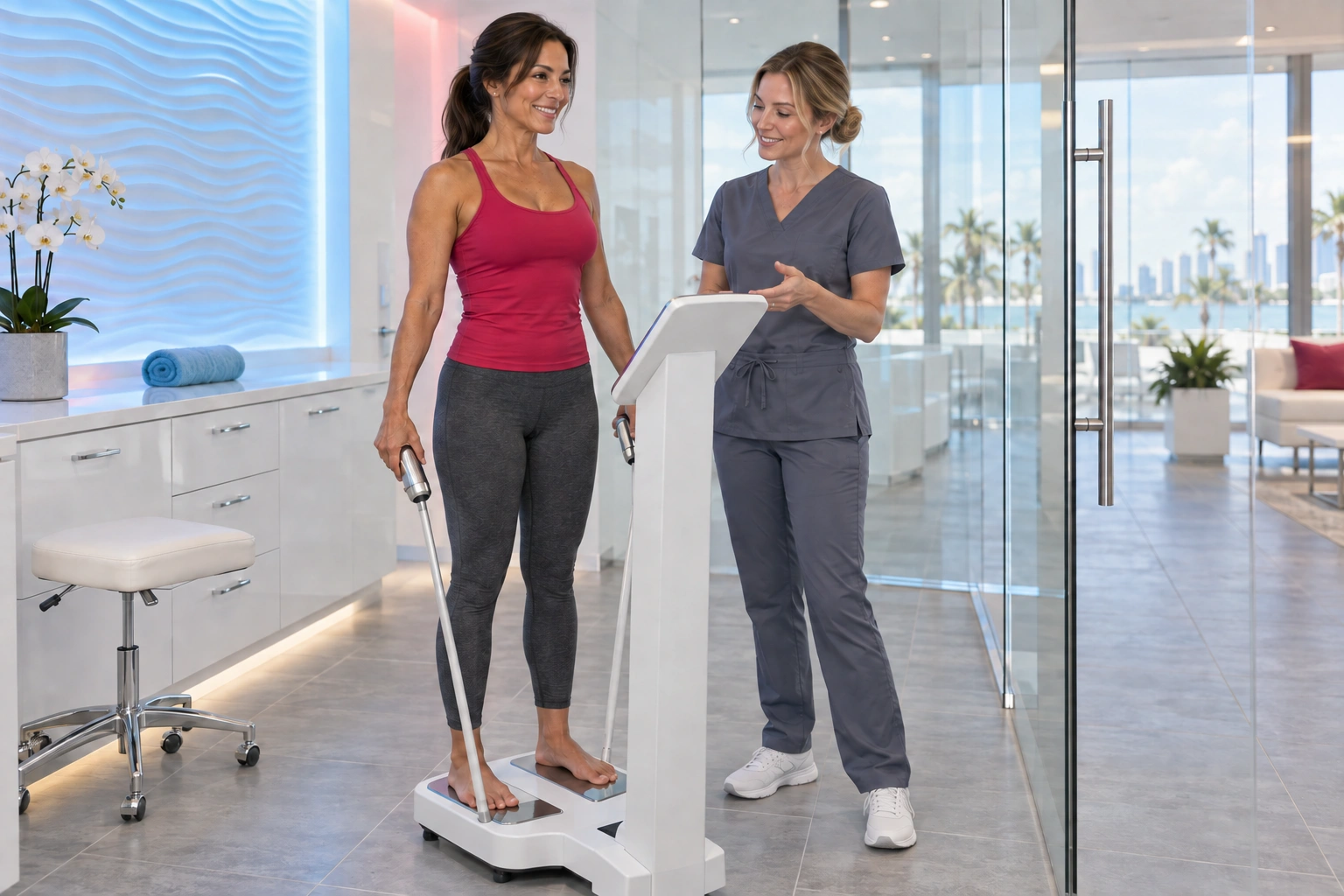
At Rewind we measure body composition and bone-relevant labs, look at where lean mass actually is rather than what the scale says, and build the training and nutrition side alongside any hormone decision. If strength and body composition are what changed, creatine plus a real training plan is frequently the highest-yield place to start. If hot flashes and sleep are what changed, that is a hormone conversation, and we would rather tell you that than sell you a supplement for it.
This article is for general education and is not medical advice. Supplement and hormone decisions depend on your individual history, medications, and kidney function, and should be made with a qualified clinician.
Sources
- Kreider RB, et al. International Society of Sports Nutrition position stand: safety and efficacy of creatine supplementation in exercise, sport, and medicine. J Int Soc Sports Nutr. pmc.ncbi.nlm.nih.gov/articles/PMC5469049/
- Creatine monohydrate for lean mass, strength, and bone density in postmenopausal women: a systematic review and meta-analysis. PubMed. pubmed.ncbi.nlm.nih.gov/42141930/
- Chilibeck PD, Candow DG, et al. Effects of creatine and resistance training on bone health in postmenopausal women. Med Sci Sports Exerc. cochranelibrary.com/central/doi/10.1002/central/CN-01254608/related-content
- Single dose creatine improves cognitive performance and induces changes in cerebral high-energy phosphates during sleep deprivation. PMC. pmc.ncbi.nlm.nih.gov/articles/PMC10902318/
- National Institute of Arthritis and Musculoskeletal and Skin Diseases. Osteoporosis. niams.nih.gov/health-topics/osteoporosis
- The Menopause Society. Menopause topics: hormone therapy. menopause.org/patient-education/menopause-topics/hormone-therapy
Frequently Asked Questions
Does creatine help with menopause symptoms?
Not the vasomotor symptoms. Creatine has not been shown to reduce hot flashes, night sweats, or vaginal dryness, and it is not a substitute for hormone therapy if those are the symptoms bothering you. What it does address is the musculoskeletal side of the menopause transition — the accelerated loss of lean mass, strength, and bone density — which is a different problem with a different solution.
How much creatine should a menopausal woman take?
Most research in postmenopausal women uses either a fixed 3 to 5 g per day of creatine monohydrate or a weight-based dose of roughly 0.1 g per kilogram of body weight daily. A loading phase is optional; skipping it simply means muscle saturation takes three to four weeks instead of about one. Monohydrate is the form nearly all of the evidence uses, and it is also the cheapest.
Will creatine make me gain weight or look bloated?
Expect roughly 1 to 3 pounds in the first weeks, and it is water drawn into muscle cells rather than fat or subcutaneous puffiness. It is intracellular, which means it generally does not read as visible bloating. Women typically see a smaller shift than men because of lower total muscle mass. If it bothers you, skipping the loading phase makes the change more gradual.
Does creatine work without resistance training?
Much less well. Across postmenopausal trials the strength, lean-mass, and bone findings come from creatine plus resistance training, and creatine alone produces substantially smaller effects. Creatine increases the amount of work your muscle can do in a session; if there is no session, there is little for it to amplify.
Is creatine safe for women over 50?
The International Society of Sports Nutrition position stand concludes that creatine monohydrate is well tolerated in healthy individuals at doses up to 30 g per day for as long as five years, including in older adults. Kidney function in the postmenopausal bone trials remained normal throughout. If you have existing kidney disease or take nephrotoxic medication, discuss it with your clinician first.
Can I take creatine alongside hormone therapy?
There is no known interaction, and the two address different problems — creatine supports muscle, strength, and bone through training, while hormone therapy addresses estrogen-driven symptoms and its own effects on bone. Many women do both. Tell your clinician what you are taking so your labs are interpreted correctly, since creatine supplementation can modestly raise serum creatinine without indicating reduced kidney function.
More in wellness
Anti-Aging in Your 30s: What to Start Now
Anti-aging in your 30s is about building a baseline, not fixing decline. What actually changes this decade, and which habits and tests pay off most.
wellnessComprehensive Lab Panel Miami: What Rewind Tests and Why
What a comprehensive lab panel should include beyond a standard physical — 30+ biomarkers across hormones, thyroid, metabolic health, and inflammation.
wellnessThe Rewind Anti-Aging Story: Why We Built This Clinic
The Rewind Anti-Aging story starts with a failing engineer in his mid-40s — and the gap in care that turned a personal fix into a Miami practice.
⚕ Medical Disclaimer
The information on this page is for educational purposes only and does not constitute medical advice, diagnosis, or treatment. All treatments at Rewind Anti-Aging of Miami are performed under the supervision of licensed medical professionals. Individual results may vary. Consult your physician before beginning any new treatment protocol.
Meet our clinical team →Not sure which treatment is right for you?
Take our free 2-minute assessment and get a personalized recommendation.
Areas We Serve in Miami & South Florida
Our clinic at 24 NW 29th Street is in Wynwood & Midtown, minutes from Edgewater and Brickell. We also care for patients across Coral Gables, Aventura, Key Biscayne, and Doral — plus the entire state of Florida via telehealth.
Take the Next Step
Our team at Rewind Anti-Aging in Miami is here to help you determine if hormone replacement therapy for women is right for your goals.