
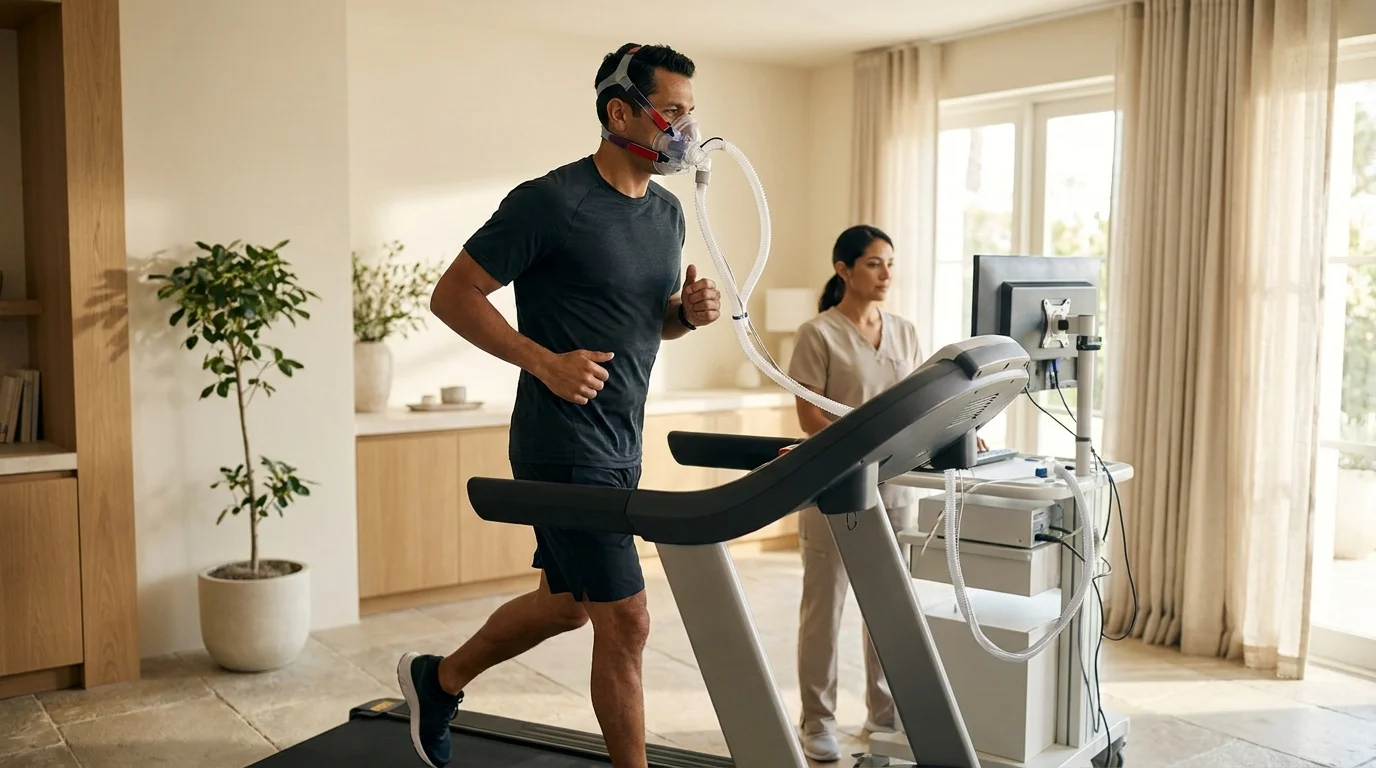
A VO2 max test measures the maximum amount of oxygen your body can use during intense exercise — and it has emerged as one of the most powerful single predictors of how long you may live. In longevity medicine, this number matters because cardiorespiratory fitness reflects the combined health of your heart, lungs, blood vessels, and muscles working together. Large studies suggest that the higher your VO2 max, the lower your risk of dying from nearly any cause. That makes it a rare metric: deeply tied to lifespan, and very much within your power to change.
If you care about healthspan — not just adding years, but staying strong and capable in them — understanding your VO2 max is a smart place to start.
What a VO2 Max Test Actually Measures
VO2 max is your body’s peak rate of oxygen consumption, usually expressed in milliliters of oxygen per kilogram of body weight per minute (ml/kg/min). The “V” stands for volume, the “O2” for oxygen, and “max” for maximal effort.
In practical terms, it captures how well your system performs three jobs at once:
- Your lungs pull oxygen into the bloodstream.
- Your heart and blood vessels deliver that oxygen-rich blood to working muscles.
- Your muscles’ mitochondria extract and burn the oxygen to produce energy.
A higher VO2 max means this whole chain is more efficient. Because so many organ systems contribute, VO2 max behaves like a whole-body fitness score rather than a measure of any single tissue. This is part of why it appears to track so closely with overall health and longevity.
Why VO2 Max Predicts Longevity

The link between cardiorespiratory fitness and lifespan is one of the more striking findings in modern preventive medicine.
A widely cited 2018 analysis published in JAMA Network Open by Mandsager and colleagues followed a large Cleveland Clinic cohort of more than 120,000 patients who underwent exercise treadmill testing (1). The researchers reported that higher cardiorespiratory fitness was associated with progressively lower all-cause mortality — with no observed ceiling, meaning the fittest individuals continued to show benefit. Notably, the study suggested that the mortality risk associated with very low fitness was comparable to, or in some comparisons greater than, the risk associated with traditional factors such as coronary artery disease, diabetes, and smoking.
Other long-running studies of cardiorespiratory fitness have pointed in the same direction (2). The consistent theme: low fitness is not a benign finding, and it appears to be one of the most modifiable mortality risk factors available.
A few reasons researchers believe this relationship is so strong:
- VO2 max integrates the health of multiple systems, so it reflects problems that single lab tests can miss.
- It is sensitive to the early, silent decline of cardiovascular and metabolic health.
- It improves with training, which means a low score is often an opportunity rather than a fixed sentence.
It’s worth a measured note here: these are observational associations. They strongly suggest that fitness and longevity travel together, but no single study proves that raising your VO2 max guarantees a longer life. Still, the weight of evidence makes cardiorespiratory fitness one of the metrics most worth tracking.
VO2 Max, Fitness Categories, and Mortality Risk
The table below offers a simplified, illustrative way to think about where a VO2 max score might fall and how fitness tiers relate to risk. Exact cutoffs vary by age, sex, and the reference population, so treat this as a conceptual guide rather than a diagnostic threshold.
| Fitness Category | Approx. VO2 Max (ml/kg/min)* | General Relationship to Mortality Risk |
|---|---|---|
| Low / Below Average | < 25 | Highest associated risk; large room to improve |
| Average | 25–35 | Moderate risk; typical for sedentary-to-lightly-active adults |
| Above Average | 35–45 | Lower associated risk |
| Excellent | 45–55 | Among the lowest associated risk tiers |
| Elite | 55+ | Lowest associated risk; typical of trained endurance athletes |
*Ranges are broad illustrations for general adult fitness and shift meaningfully with age and sex. Younger adults and men tend to have higher absolute values; the most meaningful comparison is your percentile within your own age-and-sex group.
The encouraging part is the shape of the curve. Studies suggest the largest mortality benefit often comes from moving out of the lowest fitness category — meaning the people with the most to gain are frequently those starting from the least active baseline.
How a VO2 Max Test Is Done

There are two broad approaches.
Laboratory (gold standard)
A formal VO2 max test takes place in a clinical or performance setting. You exercise on a treadmill or stationary bike while wearing a mask connected to a metabolic cart that analyzes the gases you breathe in and out. The workload increases in stages until you reach maximal effort. This direct measurement is the most accurate way to determine your VO2 max and is typically supervised for safety.
Estimated (convenient)
Many people first encounter VO2 max as an estimate from a smartwatch or fitness tracker, which infers the value from heart rate and pace data. Validated submaximal protocols — such as certain step tests, the Rockport walk test, or a graded cycle test — can also estimate VO2 max. These methods are more accessible but less precise, and they may under- or over-estimate your true number. For longevity tracking, a direct test provides the most reliable baseline.
At Rewind, VO2 max assessment fits naturally alongside our broader diagnostic testing, giving a fuller picture of how your cardiovascular and metabolic health are trending over time.
How to Improve Your VO2 Max
The good news worth repeating: VO2 max is highly trainable, often at any age. Research suggests that structured training can produce meaningful improvements within a couple of months, and the people who improve most are frequently those who started with the lowest fitness.
Strategies that studies suggest are effective include:
- High-intensity interval training (HIIT). Short, hard efforts (for example, repeated 3–4 minute pushes near your peak, with recovery between) are particularly effective at raising VO2 max.
- Zone 2 base training. Longer, easy-to-moderate aerobic sessions build the mitochondrial and cardiovascular base that supports a higher ceiling.
- Consistency over heroics. Several sessions per week, sustained over months, tends to outperform occasional all-out efforts.
- Strength and muscle preservation. Maintaining muscle mass supports oxygen utilization and protects function as you age.
- Addressing the foundation. Sleep, nutrition, body composition, and hormonal health all influence how well you adapt to training.
That last point is where a comprehensive approach matters. Suboptimal hormones, poor metabolic health, or inadequate recovery can blunt your progress no matter how well you train. A structured longevity protocol is designed to address those underlying drivers so your training translates into real gains.
For more on the bigger picture, see our guides on how to slow biological aging and the difference between biological age vs chronological age — VO2 max is one of several markers that help distinguish how old you are from how well you’re aging.
The Bottom Line

A VO2 max test gives you a number that is rare in medicine: deeply connected to how long and how well you may live, and genuinely within your control. The evidence linking cardiorespiratory fitness to lower all-cause mortality is among the most consistent in preventive health. Measuring your baseline, then working to improve it, may be one of the highest-leverage investments you can make in your long-term health.
If you’re in the Miami area and want to understand your cardiorespiratory fitness as part of a personalized longevity plan, our team can help you measure, interpret, and improve the markers that matter most. Schedule a consultation with Rewind Anti-Aging of Miami to get started.
This article is for educational purposes only and is not medical advice. Speak with a qualified healthcare provider before beginning a new exercise program or making changes to your health regimen, especially if you have a cardiovascular or other medical condition.
Sources
- Mandsager K, Harb S, Cremer P, et al. Association of Cardiorespiratory Fitness With Long-term Mortality Among Adults Undergoing Exercise Treadmill Testing. JAMA Network Open. 2018.
- Ross R, Blair SN, Arena R, et al. Importance of Assessing Cardiorespiratory Fitness in Clinical Practice: A Case for Fitness as a Clinical Vital Sign. American Heart Association Scientific Statement. Circulation. 2016.
- Kodama S, Saito K, Tanaka S, et al. Cardiorespiratory Fitness as a Quantitative Predictor of All-Cause Mortality and Cardiovascular Events in Healthy Men and Women: A Meta-analysis. JAMA. 2009.
Frequently Asked Questions
What is a good VO2 max for my age?
A good VO2 max depends on age and sex, but generally, scoring in the top quartile for your age group is associated with the lowest mortality risk in research. For many middle-aged adults, an above-average to 'excellent' rating may translate to roughly 35–50 ml/kg/min, though the exact targets shift with age. The more useful question is your fitness percentile, not a single number.
How is a VO2 max test performed?
The gold-standard VO2 max test is done in a clinic or lab on a treadmill or stationary bike while you wear a mask that measures the oxygen you inhale and the carbon dioxide you exhale. The intensity ramps up until you reach maximal effort. Estimated VO2 max can also be derived from submaximal tests, wearables, or validated step and walk tests, though these are less precise.
Can I improve my VO2 max?
Yes. Studies suggest VO2 max is highly trainable at almost any age. A combination of higher-intensity intervals and consistent aerobic base training tends to produce the largest gains, often within 8–12 weeks. Even modest improvements in cardiorespiratory fitness may be associated with meaningful reductions in mortality risk.
Is a low VO2 max really linked to a higher risk of death?
Large cohort studies, including work from the Cleveland Clinic, suggest that low cardiorespiratory fitness is associated with a substantially higher risk of all-cause mortality — in some analyses comparable to or greater than risks linked to smoking, diabetes, or high blood pressure. Fitness is a modifiable risk factor, which is part of why it draws so much attention in longevity medicine.
How often should I test my VO2 max?
For most people focused on longevity, testing once or twice a year is reasonable — often enough to track whether your training is working, but not so often that normal day-to-day variation creates noise. Your clinician may recommend a different cadence based on your goals and starting fitness.
Does VO2 max matter if I already feel healthy?
It can. VO2 max reflects how efficiently your heart, lungs, and muscles use oxygen — a measure that often reveals more about long-term health trajectory than how you feel day to day. Many people with normal labs and no symptoms still discover meaningful room to improve their cardiorespiratory fitness.
More in wellness
Comprehensive Lab Panel Miami: What Rewind Tests and Why
What a comprehensive lab panel should include beyond a standard physical — 30+ biomarkers across hormones, thyroid, metabolic health, and inflammation.
wellnessThe Rewind Anti-Aging Story: Why We Built This Clinic
The Rewind Anti-Aging story starts with a failing engineer in his mid-40s — and the gap in care that turned a personal fix into a Miami practice.
wellnessSnowbird Wellness Miami: Care That Travels With You
How seasonal residents keep hormone therapy, labs, and longevity care continuous across two states — and what to set up before you fly south or north.
⚕ Medical Disclaimer
The information on this page is for educational purposes only and does not constitute medical advice, diagnosis, or treatment. All treatments at Rewind Anti-Aging of Miami are performed under the supervision of licensed medical professionals. Individual results may vary. Consult your physician before beginning any new treatment protocol.
Meet our clinical team →Not sure which treatment is right for you?
Take our free 2-minute assessment and get a personalized recommendation.
Areas We Serve in Miami & South Florida
Our clinic at 24 NW 29th Street is in Wynwood & Midtown, minutes from Edgewater and Brickell. We also care for patients across Coral Gables, Aventura, Key Biscayne, and Doral — plus the entire state of Florida via telehealth.
Take the Next Step
Our team at Rewind Anti-Aging in Miami is here to help you determine if diagnostic testing is right for your goals.